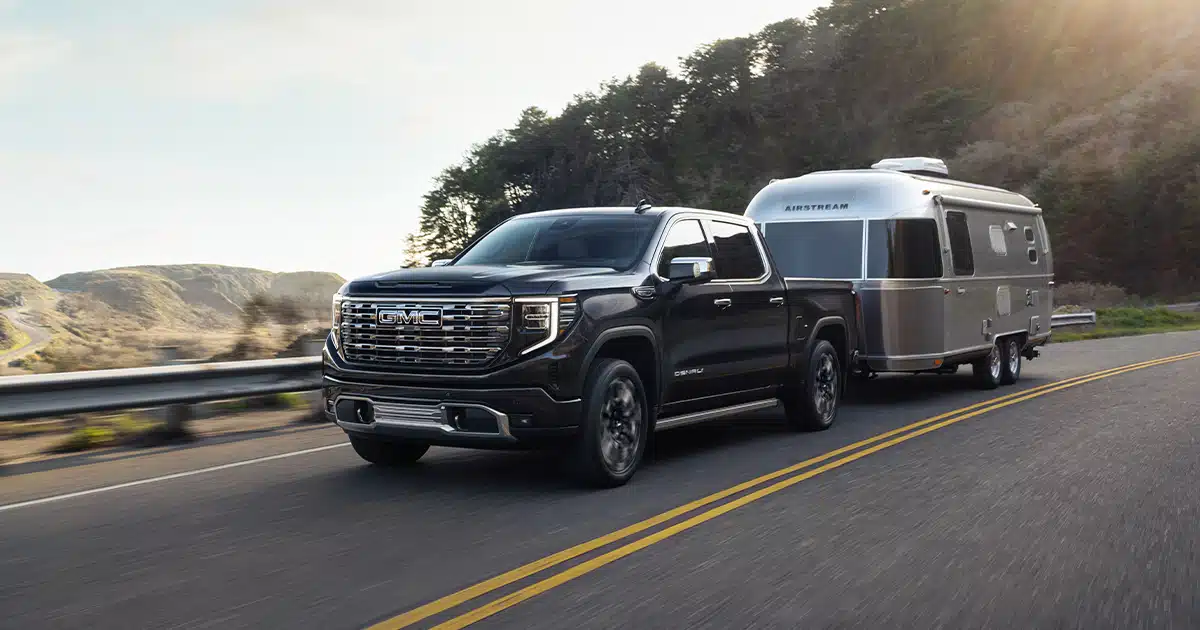
2026 Towing Capacity by Engine
2026 towing capacity by engine” is a configuration problem, not an engine problem.
Manufacturers publish a maximum that assumes a very specific combination of cab, bed, drivetrain, axle ratio, tow package content, and a controlled loading scenario.
Your real-world tow limit is usually governed by payload consumption (tongue weight + people + cargo) and the GCWR row that matches your exact build, not what the salesperson says the engine “can do.”
If you want more model-specific towing breakdowns (payload-first, hitch-type-first, configuration-first), keep your towing research organized here: Truck Report Geeks towing guides and charts.
✅ Quick Comparison Table
Exact ratings still vary by configuration and required packages.
| Segment | Model (2026) | Headline Max Conventional Tow (lbs.) | Where the number comes from |
|---|---|---|---|
| Compact/Unibody | Ford Maverick | Up to 4,000 (with 4K Tow Package context) | Ford model page (Canada) |
| Compact/Unibody | Hyundai Santa Cruz | 3,500 base / 5,000 turbo | Car and Driver summary |
| Unibody midsize | Honda Ridgeline | 5,000 | Honda Info Center |
| Midsize | Toyota Tacoma | Up to 6,500 | Toyota “Vehicles for Towing” page |
| Midsize | Ford Ranger | Up to 7,500 (guide-based approach) | Ford Ranger towing guide |
| Midsize | Chevrolet Colorado | Up to 7,700 | Chevrolet model page |
| Midsize | GMC Canyon | Up to 7,700 | GMC model page |
| Midsize | Nissan Frontier | Commonly cited up to 7,150 by configuration reporting | Reporting/spec coverage |
| Full-size | Ford F-150 | Up to 13,500 | Ford F-150 towing guide |
| Full-size | Silverado 1500 | 13,300 max available trailering | Chevrolet model page |
| Full-size | Sierra 1500 | 13,200 max diesel towing highlighted | GMC model page |
| Full-size | Toyota Tundra | Up to 12,000 | Toyota “Vehicles for Towing” page |
| Full-size | Ram 1500 | Lineup max cited up to 11,610 | Ram capability page |
| Heavy-duty | Ford Super Duty | Up to 30,000 conventional shown; up to 40,000 gooseneck shown | Ford Super Duty towing guide tables |
| Heavy-duty | Silverado 3500HD | Examples show 20,000 conventional and 31,580 gooseneck/5th for diesel configs | GM trailering guide tables |
🧰 Before the Charts: Two Rules That Prevent “Wrong Truck” Purchases
🧷 Rule 1: Payload is usually the first limit you hit
Max tow ratings assume a controlled setup.
But tongue weight, people, bed cargo, and accessories live on the truck’s payload.
Once you load family and gear, many “max tow” dreams collapse long before the engine runs out of power.
🧮 Rule 2: Use the GCWR row that matches your exact build
Ford’s towing guides explain that the charts are designed around acceptable towing performance for the listed combined weights, and that trim/options can reduce capability.
If your real truck is heavier than the “best case” assumption, your allowed trailer weight drops.
This is why “same engine” trucks can have very different ratings.
🏁 2026 Towing Capacity by Engine Charts
Important formatting note: Every chart below contains no external links (per your requirement).
All external links (maximum eight) appear only in narrative sections outside the charts.
🟩 Compact and Unibody Trucks
2026 Ford Maverick — Tow by Engine
Ford states a tow rating up to 4,000 lbs with either the 2.0L EcoBoost or 2.5L Hybrid when equipped appropriately (4K Tow Package context).
| 2026 Maverick Engine | What controls towing most | Tow Ceiling Cited |
|---|---|---|
| 2.5L Hybrid | Tow package content + cooling + hitch class | Up to 4,000 |
| 2.0L EcoBoost | Tow package content + cooling + hitch class | Up to 4,000 |
Practical Maverick takeaway: You do not buy Maverick for towing “because it’s a truck.”
You buy Maverick for towing only if the tow package content matches your plan, especially if you tow in heat, hills, or at highway speed.
2026 Hyundai Santa Cruz — Tow by Engine
Car and Driver summarizes Santa Cruz towing at 3,500 with the base four-cylinder and 5,000 with the optional turbo engine.
| 2026 Santa Cruz Engine | Typical use case | Tow Rating Cited |
|---|---|---|
| Base four-cylinder | Light utility towing | 3,500 |
| Turbo engine | Heavier towing in this platform class | 5,000 |
Practical Santa Cruz takeaway: If you routinely tow near 4,000–5,000, the turbo configuration is the correct starting point.
2026 Honda Ridgeline — Tow by Engine
Honda’s Info Center lists maximum towing capacity of 5,000 pounds.
| 2026 Ridgeline Powertrain Family | What controls towing most | Max Tow |
|---|---|---|
| Core Ridgeline engine family (lineup) | Loading discipline + accessory tow equipment | 5,000 |
Practical Ridgeline takeaway: Ridgeline can be an excellent “real life” tow vehicle in its class because it’s engineered as a stable, refined unibody.
But at 5,000 lbs, your limiting factor is often payload and tongue weight management, not “power.”
🟦 Midsize Body-on-Frame Trucks
2026 Toyota Tacoma — Tow by Powertrain
Toyota’s “Vehicles for Towing” page lists Tacoma towing capacity up to 6,500 lbs.
| 2026 Tacoma Powertrain Family | Typical towing profile | Tow Ceiling Published |
|---|---|---|
| Tacoma lineup (varies by trim/config) | Midsize towing; payload-sensitive | Up to 6,500 |
Practical Tacoma takeaway: 6,000–6,500 looks strong on paper.
In practice, travel trailer tongue weight plus passengers and cargo can make payload your bottleneck quickly.
2026 Nissan Frontier — Tow by Engine
Published reporting on the refreshed Frontier platform frequently cites towing up to 7,150 pounds depending on configuration.
Also note: Nissan Canada materials commonly cite 6,850 lbs for Frontier in certain contexts (market differences matter).
| 2026 Frontier Powertrain Family | What changes towing most | Typical “Max” You’ll See Cited |
|---|---|---|
| Core Frontier V6 family (lineup) | Cab/bed, 4×2 vs 4×4, equipment | Up to 7,150 (config-dependent) |
Practical Frontier takeaway: Frontier’s tow range is meaningful across trims and cab/bed layouts.
If you are close to the ceiling, validate your exact configuration’s rating, not the headline.
2026 Ford Ranger — Tow by Engine
Ford’s 2026 Ranger towing guide explains GCW logic and provides the “minimum powertrain needed” framing for acceptable towing performance.
| 2026 Ranger Engine (as presented in guide sections) | Towing intent | Notable Max Trailer Weight Shown |
|---|---|---|
| 2.3L EcoBoost I4 | Mainstream tow build | 7,500 ceiling context |
| 2.7L EcoBoost V6 | Torque-forward midsize towing | 7,500 ceiling context |
| 3.0L high-performance application shown | Performance/off-road bias | Lower number shown in table section |
Practical Ranger takeaway: This is the perfect example of “more horsepower does not guarantee more towing.”
A performance/off-road setup can tow less than a mainstream tow-oriented build.
2026 Chevrolet Colorado — Tow by Engine
Chevrolet markets Colorado with 7,700 lbs max towing capability on the model page.
| 2026 Colorado Engine Family | What controls towing most | Tow Ceiling Published |
|---|---|---|
| Primary 2.7L turbo family | Trailering package + configuration | Up to 7,700 |
Practical Colorado takeaway: Colorado can be a midsize tow leader when configured correctly.
But some trims (like ZR2) are explicitly noted as towing less in third-party coverage, reinforcing the “trim mission matters” rule.
2026 GMC Canyon — Tow by Engine
GMC markets Canyon with towing up to 7,700 lbs on the model page.
| 2026 Canyon Engine Family | What controls towing most | Tow Ceiling Published |
|---|---|---|
| TurboMax 2.7L family | Configuration + trailering equipment | Up to 7,700 |
Practical Canyon takeaway: With a simplified powertrain story, your win/loss comes down to equipment content and chassis setup, not engine shopping.
🟥 Full-Size Half-Ton Trucks
2026 Ford F-150 — Tow by Engine
Ford’s 2026 F-150 towing guide is explicit that max towing varies by cargo, configuration, accessories, and passengers.
| 2026 F-150 Engine (as shown in guide families) | Typical towing profile | Max Conventional Tow Shown |
|---|---|---|
| 2.7L EcoBoost V6 | Efficient tow + daily blend | Up to 8,400 in guide tables |
| 3.5L EcoBoost V6 | Highest max-tow ceiling | Up to 13,500 |
| 3.5L High Output (Raptor context) | Off-road/performance mission | Around 8,200 shown |
| 5.2L Supercharged (Raptor R context) | Halo performance | Around 8,700 shown |
Practical F-150 takeaway: If you want 13,500, do not shop “F-150.”
Shop the exact towing table row that produces 13,500, then back into trim and options.
2026 Silverado 1500 — Tow by Engine
Chevrolet markets 13,300 lbs max available trailering on the 2026 Silverado 1500 page.
| 2026 Silverado 1500 Engine FamiliesWhat changes tow rating mostHeadline Max Available Trailering | ||
|---|---|---|
| TurboMax 4-cylinder family | Tow package + cab/bed + drivetrain | 13,300 (model max) |
| 5.3L V8 | Tow package + configuration | 13,300 (model max) |
| 6.2L V8 | Tow package + configuration | 13,300 (model max) |
| 3.0L Duramax diesel | Tow package + configuration | 13,300 (model max) |
Practical Silverado takeaway: The page gives you the ceiling.
Your real number is a configuration output, and you should expect meaningful spread by drivetrain and layout.
2026 Sierra 1500 — Tow by Engine
GMC highlights max diesel towing capacity up to 13,200 lbs on the Sierra 1500 page.
| 2026 Sierra 1500 Engine Families | What changes tow rating most | Highlighted Tow Claim |
|---|---|---|
| Duramax diesel (light-duty) | Correct configuration + tow equipment | Up to 13,200 |
| Gas engine families | Trim/configuration dependent | Varies (ceiling depends on build) |
Practical Sierra takeaway: When an OEM calls out diesel max towing, they are pointing you toward the configuration that hits the published ceiling.
Treat it as a “build target,” not a guarantee for every diesel badge.
2026 Ram 1500 — Tow by Engine
Ram’s capability page cites up to 11,610 lbs max towing for the lineup.
The 5.7L HEMI section commonly highlights 11,320 as a max towing figure in materials tied to that engine.
| 2026 Ram 1500 Engine Families (as published in official/press materials) | Towing intent | Max Tow Figures Commonly Cited |
|---|---|---|
| 3.6L V6 eTorque | Lighter towing | Up to 8,130 |
| 5.7L HEMI V8 eTorque | Traditional max-tow approach | Up to 11,320 |
| Higher-output Hurricane I-6 variants | Performance + capability depending on trim | Lineup max cited up to 11,610 |
Practical Ram takeaway: When you see multiple max tow numbers, assume multiple “best case” builds.
Validate which engine and which equipment set the published number refers to before you buy.
2026 Toyota Tundra — Tow by Powertrain
Toyota’s “Vehicles for Towing” page states the Tundra towing capacity up to 12,000 lbs.
| 2026 Tundra Powertrain Families | Typical towing profile | Tow Ceiling Published |
|---|---|---|
| Tundra lineup (varies by trim/config) | Full-size towing with modern tow tech | Up to 12,000 |
Practical Tundra takeaway: Treat 12,000 as the ceiling, then shop the configuration that actually achieves it.
In real towing, payload and wheelbase choices still matter.
🟧 Heavy-Duty Trucks (Where Hitch Type Changes Everything)
2026 Ford Super Duty — Conventional vs Gooseneck/5th by Engine
In Ford’s 2026 Super Duty towing guide tables, conventional towing entries can reach 30,000 lbs in select configurations, and gooseneck/5th-wheel entries can reach 40,000 lbs when properly equipped.
| 2026 Super Duty Diesel Families (table-based view) | Conventional Tow Shown | Gooseneck/5th Tow Shown |
|---|---|---|
| 6.7L diesel (various configurations) | Up to 30,000 | Up to 40,000 |
Practical Super Duty takeaway: In HD towing, the engine matters, but the hitch type and axle/chassis package dictate the real plan.
If you are towing 5th-wheel/gooseneck, you must shop payload sticker first.
2026 Chevrolet Silverado HD (2500HD / 3500HD)
GM’s 2026 trailering guide tables show how dramatically ratings move between gas and diesel, and between conventional and gooseneck/5th.
| 2026 Silverado 3500HD Example Lines (as shown in tables) | Engine | Max Conventional | Max Gooseneck/5th |
|---|---|---|---|
| 3500HD Double Cab Long Bed 2WD DRW | 6.6L gas V8 | 18,300 | 18,300 |
| 3500HD Double Cab Long Bed 2WD DRW | 6.6L Duramax diesel | 20,000 | 31,580 |
Practical Silverado HD takeaway: HD diesel doesn’t just add torque.
It often unlocks higher GCWR rows and higher gooseneck/5th ratings, which can change which trailers you can realistically buy.
🧠 Spec It Right: How to Determine Your Real Tow Limit
📌 Step 1: Decide conventional vs gooseneck/5th-wheel early
If you’re in travel trailers, you’re usually in conventional towing.
If you’re in large toy haulers or true “big trailer” territory, gooseneck/5th-wheel may be the stability strategy.
This decision affects truck class selection more than the engine badge does.
📌 Step 2: Build your load plan before you shop engines
Write this down:
Passengers and pets (realistic count).
Bed cargo (tools, coolers, generators, firewood).
Hitch hardware (weight distribution systems can be heavy).
Trailer tongue weight (which lives on payload).
If that plan is not written down, you’re guessing.
📌 Step 3: Apply a practical margin
Even if your trailer is “under max tow,” hills, heat, wind, and altitude change what the experience feels like.
A comfortable tow build often sits below the published ceiling, not right on it.
✅ Which Truck Category Fits Which Trailer Weight
🟩 Under 3,500 lbs
Maverick (properly equipped) and Santa Cruz base can work for light towing.
Your success factor is trailer setup quality and loading discipline more than engine power.
🟩 3,500–5,000 lbs
Ridgeline and turbo Santa Cruz live here, and Maverick can live here when equipped properly.
At this weight class, payload and tongue weight usually decide how “easy” towing feels.
🟦 5,000–7,700 lbs
This is midsize towing territory: Tacoma, Frontier, Ranger, Colorado, Canyon depending on configuration.
Expect meaningful differences by trim mission (off-road trims often tow less).
🟥 7,700–13,500 lbs
Half-tons dominate here: F-150, Silverado 1500, Sierra 1500, Ram 1500, Tundra.
If you’re close to 10,000+ often, stop thinking “max tow.”
Start thinking “payload sticker and wheelbase.”
🟧 13,500+ and serious 5th-wheel/gooseneck
Heavy-duty trucks exist for a reason, and the tables illustrate why conventional vs gooseneck changes everything.
If you’re shopping 5th-wheel, payload is the spec that ends arguments.
❓ FAQs
Why can two trucks with the same engine tow different amounts?
Because towing is rated on the entire vehicle system: drivetrain, axle ratio, wheelbase, cooling, brakes, tires, hitch receiver, and the weight of the truck itself
Why do some off-road/performance trims tow less?
Because those trims are optimized for a different mission.
They may have different tires, suspension tuning, cooling strategy, weight, or drivetrain logic, and the towing table reflects that.
Is “max tow” a safe target to tow at all the time?
It is a tested, engineered limit under defined assumptions.
But comfort, stability margins, and real-world loading often suggest towing below the ceiling when you tow frequently.
What is the fastest way to pick the right truck?
Pick the trailer first.
Estimate loaded trailer weight realistically.
Estimate tongue weight.
Confirm the truck’s payload sticker can carry tongue weight plus people and gear.
Then confirm the towing guide row for your exact configuration supports the trailer weight.
Conclusion
This combined 2026 master article covers every truck you listed and aligns the numbers with how manufacturers and reputable spec coverage frame towing: maximums are real, but they are configuration-conditional.
If you want, I can also create a second companion piece that is purely trim-by-trim decision logic (what to avoid, what to prioritize, and which packages unlock which ceilings) for each model category.
Reminder: If this helped, please like and comment with (1) what you tow, (2) your realistic loaded trailer weight, and (3) how many passengers and how much gear you typically carry, so the next 2026 engine chart can be tailored to your exact use case.