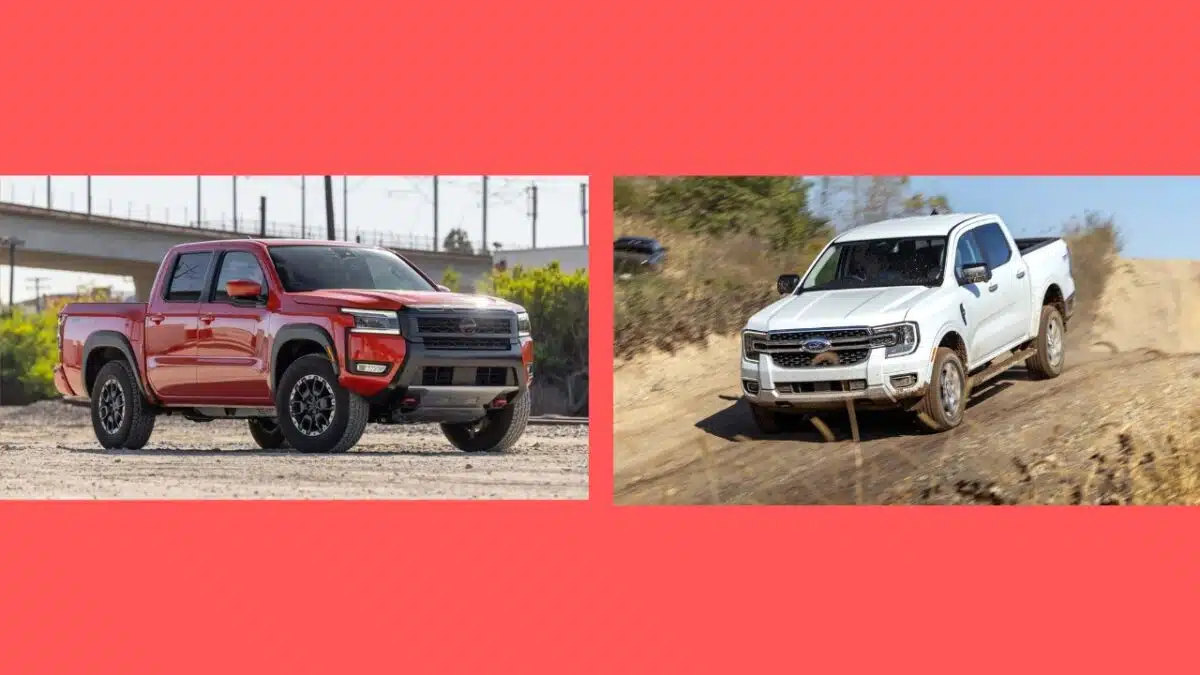
Nissan Frontier or Ford Ranger
If your top priority is max towing and payload and you want the newest platform feel, the Ford Ranger is usually the smarter buy (up to 7,500 lb towing and up to 1,684 lb payload when properly equipped).
If you want a simpler, proven V6-only lineup, a more traditional feel, and strong capability with fewer configuration rabbit holes, the Nissan Frontier remains a strong value play (up to 6,850 lb towing and up to 1,340 lb payload in Canada-spec highlights).
Head-to-head comparison table
| Category | 2025 Nissan Frontier | 2025 Ford Ranger |
|---|---|---|
| Max towing (when properly equipped) | Up to 6,850 lb | Up to 7,500 lb |
| Max payload (when properly equipped) | Up to 1,340 lb | Up to 1,684 lb |
| Base/volume engine strategy | One main engine (V6) | Multiple engines (I4, V6, performance V6) |
| Off-road focus trims | PRO-4X (and related) | FX4, Tremor packages (market dependent), Ranger Raptor (performance) |
| How it “buys” | Straightforward builds | More configuration leverage (and more ways to overspend) |
The big question: what are you really buying a midsize truck for?
Most “Frontier vs Ranger” decisions are not actually about brand loyalty.
They are about use-case fit: towing frequency, bed use, commute comfort, winter traction, trail use, and how much complexity you’re willing to accept in exchange for higher ceiling performance.
So the right way to choose is to start from work patterns, not brochure highlights.
Capability: towing and payload (where the Ranger usually wins)
Ford Ranger towing: the consistent headline number is 7,500 lb
With the right equipment, the 2025 Ranger is engineered for up to 7,500 lb maximum towing.
Ford also publishes a dedicated towing guide that breaks towing out by engine and configuration, which matters because capability is not just “engine” — it’s axle ratio, 4×4 hardware, curb weight, passengers, cargo, and hitch setup.
Nissan Frontier towing: strong, but a lower ceiling in Canada highlights
Nissan Canada positions the 2025 Frontier at up to 6,850 lb of towing.
That is enough for many common real-world trailers: utility trailers, smaller campers, two-place snowmobile trailers, light equipment, and many mid-sized travel trailers if you stay disciplined on loaded weight and tongue weight.
But if you’re consistently towing near the top end of midsize capability, the Ranger’s higher ceiling is meaningful — not because you should tow at the limit all the time, but because having more margin usually improves stability and reduces “white knuckle” towing in wind and hills.
Payload: the most ignored spec that becomes your daily regret
Most owners obsess over towing, then discover payload is what limits them first.
Payload is what you “spend” when you add: people, dogs, toolboxes, cap/canopy, bed rack, coolers, firewood, generator, and trailer tongue weight.
Ford lists Ranger payload up to 1,684 lb.
Nissan lists Frontier payload up to 1,340 lb.
That ~300+ lb difference can be the difference between:
- comfortably carrying a family plus a loaded bed, versus constantly recalculating what must stay behind, or
- towing a heavier travel trailer (with higher tongue weight) without exceeding the truck’s payload sticker.
Engines and powertrains: simplicity vs optionality
Frontier: one core engine strategy (predictable ownership)
The 2025 Frontier is positioned around a 3.8L V6 making 310 hp and 281 lb-ft of torque paired to a 9-speed automatic in commonly cited specs.
This matters because ownership experience tends to be more consistent:
You do not have to decode “which engine is the good one.”
You do not have to optimize a build around towing ratios and power curves across multiple engine families.
You generally pick cab/bed/drivetrain/trim, and you’re done.
That simplicity has real value if you keep vehicles a long time or you share the truck with family members who don’t want a “special” setup.
Ranger: multiple engine choices (higher ceiling, more decision risk)
The 2025 Ranger lineup is commonly presented with:
- a standard 2.3L EcoBoost I4,
- an available 2.7L EcoBoost V6, and
- a high-performance 3.0L EcoBoost V6 in Ranger Raptor.
That optionality can be a win if you want to tailor the truck to your priorities (daily efficiency vs torque vs performance).
But it also increases the odds of buying the “wrong” configuration for your real usage, especially if you are influenced by a short test drive rather than your year-round routine.
Real-world fuel costs: what matters more than brochure numbers
Fuel economy conversations are often misleading because:
- winter temperatures,
- short trips,
- idling,
- roof racks/AT tires, and
- towing even small trailers
can dominate your real-world fuel spend.
For Frontier, Canadian dealer listings commonly show estimates around 13.1 L/100 km city / 10.5 highway / 11.9 combined (varies by configuration and conditions).
For Ranger, Canadian testing commentary indicates the V6 may use under 1 L/100 km more than the four-cylinder on combined ratings, and winter testing can push consumption higher depending on conditions and driving.
Practical buying guidance:
If you do mostly commuting with occasional weekend truck tasks, you should treat engine choice as a total-cost decision, not a “feel” decision.
If you tow monthly (or more), prioritize stability and margin first; fuel spend becomes secondary because towing dwarfs the baseline differences anyway.
Ride, handling, and everyday drivability
Steering, braking, and “truck feel”
In daily use, most buyers notice:
- brake feel under load,
- steering stability at highway speed,
- lane tracking in crosswinds, and
- how the rear suspension behaves when the bed is empty.
The Ranger’s modern design and towing focus tends to translate into strong stability when properly equipped, especially for owners who do frequent highway runs.
The Frontier tends to appeal to owners who want a more traditional, predictable midsize truck experience without the sense that you are driving a “systems-managed” vehicle.
Your best move is to test drive both on the same roads you actually use, including:
- a rough section of pavement,
- a highway merge, and
- a parking lot with tight turns.
Then repeat the test drive with your normal passenger load if possible.
Cab, bed, and usability: where the details decide the winner
Cab size and rear-seat reality
A midsize truck can either be:
- a true family vehicle that also hauls, or
- a two-adult truck with occasional rear-seat use.
When you compare Frontier and Ranger, pay attention to:
- rear seat knee room with the front seat set to your driving position,
- rear door opening angle (child seat loading), and
- rear under-seat storage volume.
If you are routinely carrying adults in back, your “best truck” becomes the one that reduces fatigue and complaints — not the one with a slightly better spec sheet.
Bed length and how you actually load cargo
Most owners think in terms of “bed length,” but live in terms of:
- tie-down availability,
- bed width between wheel wells,
- step/bumper usability, and
- whether your gear requires a tonneau/cap.
If you plan to add:
- a canopy,
- ladder rack,
- rooftop tent platform, or
- bed slide system,
then payload becomes even more critical, and the Ranger’s higher payload ceiling can be a genuine advantage.
For practical bed setup ideas, see TruckReportGeeks bed-accessory planning guide (internal).
Off-road and winter capability: be honest about your terrain
Frontier PRO-4X style buyer
Frontier off-road oriented trims commonly attract buyers who want:
- rugged simplicity,
- predictable low-speed control, and
- a truck that feels designed for “get there and get back” reliability rather than outright performance.
Nissan highlights 4×4 capability and its towing/payload positioning on official pages, and the Frontier’s torque figure is clearly presented in Canada materials.
Ranger FX4 / Ranger Raptor style buyer
Ranger buyers split into two camps:
- those who want capability with restrained cost (typical 4×4 + tow package builds), and
- those chasing high-speed off-road performance (Raptor mindset).
Ford’s Ranger Raptor positioning includes a 3.0L EcoBoost V6 with 405 hp and 430 lb-ft in U.S. model details.
Important: Ranger Raptor-style performance trims often trade some towing capacity for off-road hardware and tuning, so if towing is core to your life, you must verify the tow rating of the exact trim you are buying.
Tech and infotainment: what matters, what is noise
The features that actually change your ownership experience
Ignore the gimmicks and focus on:
- camera quality and usefulness (especially for hitching),
- trailer sway/backup support features,
- wireless phone integration stability,
- physical buttons for core functions (gloves + winter use), and
- how quickly the system boots and reconnects.
A truck is not a phone.
If infotainment glitches frustrate you, you will hate the vehicle even if it is “best in class” on paper.
Driver assistance: helpful, but don’t buy it blind
Modern driver assistance can reduce fatigue, but it is not a substitute for:
- good mirrors,
- stable suspension, and
- correct tires for your region.
Test the systems on real roads before you decide they matter.
Pricing and trims: where value can flip depending on incentives
Pricing changes fast, and incentives can turn a “worse value” truck into the smarter buy for your market.
That said, the Ranger’s trim structure and MSRP references are widely published in Canadian research listings.
Use MSRP as a baseline, then compare:
- real transaction prices,
- interest rates,
- lease residuals (if leasing), and
- insurance deltas between trims.
For negotiation strategy and how to compare “apples to apples” builds, see TruckReportGeeks truck buying checklist (internal).
Reliability and long-term ownership: what to look at before you sign
Instead of generic “reliability scores,” evaluate what you can control:
- powertrain simplicity vs complexity,
- availability and cost of common wear items (tires, brakes),
- dealer service reputation in your area,
- warranty coverage and exclusions,
- how long you plan to keep the truck, and
- whether you are the kind of owner who follows maintenance intervals aggressively.
Frontier’s single-engine strategy can be appealing for long-term owners who value predictability.
Ranger’s configuration range can be excellent if you pick the right setup, but it increases your burden to confirm that your exact build matches your towing, payload, and daily comfort needs.
Which one should you buy? (scenario-based decision)
Buy the Ford Ranger if…
🔧 You tow frequently and want maximum margin up to 7,500 lb.
📦 You regularly carry heavy payload (people + gear + tongue weight) and want the higher ceiling up to 1,684 lb.
🛠️ You like configuring a vehicle to your needs and will research the exact combination of engine, tow package, and axle ratio.
🌲 You want an upgrade path into higher-performance off-road variants (and accept the tradeoffs).
Buy the Nissan Frontier if…
🧰 You want a simpler lineup with a clear V6 powertrain identity (310 hp / 281 lb-ft highlighted in Canada materials).
🚚 Your towing needs fit comfortably under 6,850 lb, and you prioritize “enough capability” over the highest ceiling.
🧱 You value straightforward ownership and don’t want to overthink configurations.
🏕️ You want a midsize truck that feels traditional and predictable in daily use.
Ownership cost traps to avoid (for both trucks)
- Ignoring the payload sticker.
A brochure payload number is not your truck’s payload.
Your truck’s payload is the door-jamb label on the specific VIN you buy.
- Overbuilding the off-road look.
A/T tires, heavy wheels, lifts, racks, skids, and caps can quietly destroy payload and increase fuel consumption.
- Assuming tow rating equals “comfortable towing.”
Stability comes from wheelbase, suspension tuning, brake confidence, trailer setup, and how close you are to payload and rear axle limits.
- Buying a trim for a feature you won’t use weekly.
Spend on what you touch every day: seat comfort, visibility, towing aids, and storage.
FAQs
Which truck tows more: Frontier or Ranger?
In the commonly published Canadian highlights for 2025 models, the Ranger reaches up to 7,500 lb when properly equipped, while the Frontier is positioned at up to 6,850 lb
Which has higher payload?
The Ranger is listed up to 1,684 lb payload, while the Frontier is listed up to 1,340 lb payload in Nissan Canada highlights.
Is the Frontier V6 powerful enough compared with the Ranger?
The Frontier’s 3.8L V6 is commonly cited at 310 hp and 281 lb-ft.
The Ranger offers multiple engine choices and can reach much higher output in performance variants like Ranger Raptor (U.S. model details list 405 hp / 430 lb-ft), but that’s a different buyer profile with different tradeoffs
Should I choose based on engine alone?
Not by itself.
Choose based on payload, tow setup, and your real weekly use.
If you do not tow often, drivability and comfort can matter more than peak output.
What is the single most important thing to check before buying either?
The door-jamb payload label on the exact truck you’re buying.
That label determines how much cargo and tongue weight you can safely carry, regardless of marketing claims.
Sources
- 2025 Ford Ranger Towing Guide (Official PDF)
- 2025 Nissan Frontier Towing & Payload (Nissan Canada)
- 2025 Ford Ranger Overview: Payload & Towing Highlights (Ford Canada)
Bottom line
If you want the higher ceiling for towing and payload, and you are willing to be intentional about configuration, the Ford Ranger is typically the better “do more, grow into it” midsize truck.
If you want a straightforward V6 midsize truck with strong capability and less configuration complexity, the Nissan Frontier remains an excellent “buy it, use it, keep it” option—especially if your towing needs stay comfortably below its limit.
Reminder: If this helped, like and comment with how you actually use your truck (towing, camping, worksite, winter driving), and visit us again Truck Report Geeks.