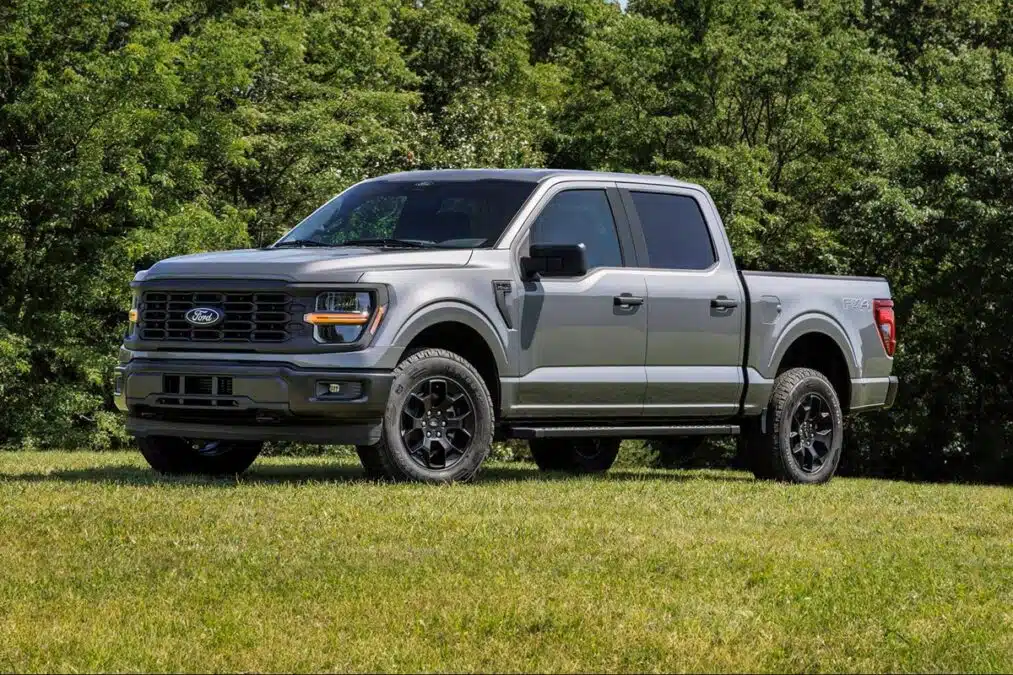
2026 Ford F-150
The 2026 Ford F-150 is fundamentally a “refined carryover” year with meaningful packaging and feature availability changes—exactly what most truck buyers want: the proven 14th-gen platform (updated recently) with incremental improvements where they matter.
Ford still leads with capability, headlined by 13,500 lbs max available towing and 2,440 lbs max available payload (when properly configured).
If you want the shortest version of this article: pick your truck backwards—start with your heaviest trailer or payload day, then choose the cab/bed, axle ratio, and package that makes those numbers real.
📊 Quick Comparison Table (engines & capability snapshot)
| Engine (2026 F-150) | HP | Torque (lb-ft) | Max tow (lbs) | Best for |
|---|---|---|---|---|
| 2.7L EcoBoost V6 | 325 | 400 | 8,400 | Daily driving, light towing, value builds |
| 5.0L Ti-VCT V8 | 400 | 410 | 12,800 | Traditional V8 feel, strong towing, simple power delivery |
| 3.5L EcoBoost V6 | 382 | 500 | 13,500 | Max tow builds, heavy conventional trailers |
| 3.5L PowerBoost Hybrid | 420 | 578 | 11,600 | Torque + efficiency + onboard power (Pro Power) |
Notable headline number: Ford lists 640 lb-ft max available torque across the range—this aligns with the high-output performance end of the lineup (e.g., Raptor R is commonly published at 700 hp / 640 lb-ft).
For more towing-focused resources, you can also bookmark TruckReportGeeks.com.
✅ What’s new (or notably different) for 2026
Ford’s own model page emphasizes upgraded packages and feature availability rather than a redesign.
Key changes and highlights called out in Ford-facing and industry coverage include:
- F-150 Lobo™ Package: Ford positions this as a more aggressive, street-forward appearance/performance vibe (not a full redesign, but a notable “personality” package).
- New appearance packaging such as XLT Chrome Appearance and Platinum Satin Appearance Package (Ford explicitly calls these out as new/upgraded packaging).
- Expect the broader truck to feel “mostly unchanged” mechanically—typical of a mature model cycle.
🧭 Trim lineup and who each trim is for
Ford’s consumer-facing page frames the 2026 F-150 as 8 trims, with major capability and tech available as you climb the ladder.
Here’s the practical buyer map (what the trim actually means in the real world):
🛠️ XL (work-first value)
If you want the lowest-cost entry to a full-size truck that can still be built into a tow rig, XL is the foundation.
Ford highlights items like the 12-inch center display, SYNC 4, and available connectivity/security packages, with a standard 2.7L EcoBoost and available Tow/Haul equipment depending on build.
Buy XL if: you’re building a fleet/work truck, or you’re an “options à la carte” buyer who knows exactly what you want.
🧱 STX (value + appearance)
STX is typically the “best-looking affordable” F-150.
It’s also where Ford calls out the Lobo™ Package joining the lineup as a major styling/attitude option for 2026.
Buy STX if: you want a sharp-looking truck without paying Lariat money.
🧰 XLT (sweet spot for most buyers)
XLT is where the “family + towing + daily comfort” formula gets easy.
Industry guidance commonly recommends XLT with towing/tech packages for value.
Buy XLT if: you want the best balance of resale, features, and customization flexibility.
Lariat (tech comfort without luxury-tax pricing)
Lariat is where premium features start to feel “standard,” and Ford explicitly calls out availability of tools like the Pro Access Tailgate via bed utility packaging.
Buy Lariat if: you want heated/ventilated-style comfort, stronger audio/lighting, and want to option into advanced towing tech without going full-luxury.
🏔️ Tremor (off-road capability without full Raptor commitment)
Tremor is the “real-world off-road” trim: trails, snow, ranch roads, and weekend abuse—while staying livable.
Mainstream reviewers frequently note Tremor as the most balanced off-road choice for daily drivability.
Buy Tremor if: you off-road regularly but still commute.
🤠 King Ranch (western luxury theme)
King Ranch is essentially luxury equipment with distinct materials and appearance cues.
Ford highlights BlueCruise availability and higher-output comfort/tech features at this tier.
Buy King Ranch if: you want premium without the Platinum aesthetic, and you care about interior theme.
🏁 Platinum (modern luxury theme + premium packaging)
Platinum is the flagship “modern” luxury look, and Ford directly promotes a Platinum Satin Appearance Package as part of 2026’s packaging emphasis.
Buy Platinum if: you want max comfort, premium exterior finishes, and the most “executive” daily-driver feel.
Raptor (and Raptor R in broader coverage)
If your goal is high-speed desert/off-road performance, Raptor is in its own category.
MotorTrend’s 2026 coverage continues to position Raptor and Raptor R as the performance halo, with published output figures up to 700 hp / 640 lb-ft for Raptor R.
Buy Raptor/Raptor R if: you want the off-road performance identity, not just capability numbers.
⚙️ Engine lineup: how to pick the right one
Ford’s 2026 F-150 engine story is simple: multiple proven powertrains, and the “best” engine depends on how you tow and how often.
2.7L EcoBoost: the smart daily driver
Ford lists 325 hp / 400 lb-ft and up to 8,400 lbs max towing depending on configuration.
Pick it when:
- Your trailer is typically under ~7,000–8,000 lbs.
- You want strong low-end response without paying for max-tow hardware.
5.0L V8: the traditionalist’s tow motor
Ford lists 400 hp / 410 lb-ft, and up to 12,800 lbs towing.
Pick it when:
- You value linear throttle feel and V8 character.
- You tow heavy, but not always at the max rating.
3.5L EcoBoost: the max conventional tow choice
Ford puts the headline here: 382 hp / 500 lb-ft and 13,500 lbs max available tow rating.
Pick it when:
- You tow a travel trailer, equipment trailer, or large boat regularly.
- You want the highest conventional tow rating in the lineup.
3.5L PowerBoost Hybrid: torque + onboard power
Ford highlights 420 hp / 578 lb-ft, with up to 11,600 lbs tow rating and access to Pro Power Onboard for real jobsite/tailgate electricity.
Pick it when:
- You want a truck that doubles as a mobile generator.
- You tow mid-to-heavy loads but also care about efficiency and utility power.
🧲 Towing & payload: the numbers that matter (and how to make them real)
Ford headline capability (when properly configured):
- Max available towing: 13,500 lbs
- Max available payload: 2,440 lbs
The four “levers” that control your real towing capacity
- Cab/bed configuration
Bigger cabs and shorter beds often reduce payload and can change tow ratings. - Engine choice
Ford spells out max towing by engine clearly (shown earlier in the table). - Axle ratio + tow package
Ford’s spec tables show tow ratings tied to axle ratios and note cases where the Max Tow/Haul Package is required for top numbers. - Payload (the silent limiter)
Even if your truck can pull 13,500 lbs, payload gets eaten fast by:
- passengers
- cargo in the bed
- the hitch’s tongue weight (often ~10–15% of trailer weight)
If you want a simple rule: for a 9,000 lb trailer, tongue weight could be ~900–1,350 lbs before you add people and gear.
Engine-by-engine max towing (Ford)
Ford’s own breakdown for max available tow ratings:
- 2.7L EcoBoost: 8,400 lbs
- 3.5L PowerBoost: 11,600 lbs
- 3.5L EcoBoost: 13,500 lbs
- 5.0L V8: 12,800 lbs
If you want to go deeper on towing selection logic, keep a dedicated bookmark to TruckReportGeeks.com for your broader truck research.
🧰 Bed utility and “worksite” features that matter in 2026
Pro Access Tailgate
Ford explicitly markets the Pro Access Tailgate as improving bed access even when hitched to a trailer—this is a genuinely practical advantage if you tow frequently.
Practical impact:
- easier reach into the bed with a trailer connected
- less climbing/leaning
- faster loading/unloading at the hitch
Pro Power Onboard (mobile electricity)
Ford positions Pro Power as “power at the ready” with multiple output levels depending on build, including availability up to 7.2 kW on applicable configurations.
Use cases:
- jobsite tools (saws, compressors, charging)
- camping/RV support
- tailgating setups
- emergency home backup (with proper planning and safety equipment)
🧠 Tech, connectivity, and driver assistance
BlueCruise hands-free highway driving
Ford states BlueCruise availability on higher trims (and select XLT builds), positioning it as “Eyes on. Hands off.” hands-free driving on mapped highways.
If you care about this, validate availability on the exact trim + equipment group you’re ordering.
Displays and infotainment
Ford highlights 12-inch center displays and SYNC 4 across core trims (even XL).
Most mainstream reviews also emphasize strong in-cabin storage and “mobile workspace” features (like fold-down shifter/work surface on equipped trucks).
🧱 Cab/bed configurations (why it changes everything)
Car and Driver summarizes that the F-150 is offered with regular cab, SuperCab, and SuperCrew, with bed lengths ranging from 5.5 to 8.0 feet.
Your decision here should be driven by:
- how many adults you carry weekly
- how often you carry motorcycles/ATVs/materials
- whether your truck must fit in a garage
- whether you tow often enough to justify optimizing wheelbase and payload
💰 Pricing and how to shop intelligently
Pricing moves constantly, so the most accurate step is always Ford’s own Build & Price tool.
Start here: Build & Price the 2026 F-150 on Ford.com.
For third-party market context, MotorTrend publishes a wide estimated price range for 2026 F-150 coverage (varies by trim and configuration).
Shopping advice that consistently saves money:
- pick trim for the interior/tech you truly need
- add towing packages intentionally (don’t assume they’re included)
- validate payload on the door sticker expectation for your build style (crew cab luxury builds can surprise you)
🧾 Quick “best build” recommendations (based on use)
Best max-tow conventional trailer build
- 3.5L EcoBoost
- Tow/Haul + Max Tow/Haul as required
- Configuration that supports the top tow rating
This is the direct path to Ford’s 13,500 lbs max towing headline.
Best all-around family + towing
- XLT or Lariat with towing tech packages
- Choose engine based on your typical trailer weight
This aligns with mainstream buying guidance: stop around XLT/Lariat and option smartly.
Best “truck-as-a-generator”
- PowerBoost hybrid + Pro Power Onboard
Ford spotlights this powertrain’s torque and towing plus onboard power utility.
Best off-road daily driver
- Tremor (or FX4 on a mainstream trim)
Often called the balanced off-road pick versus going full Raptor.
❓ FAQs (2026 Ford F-150)
What is the max towing capacity of the 2026 Ford F-150?
Ford lists 13,500 lbs max available towing when properly configured.
Which engine tows the most in the 2026 F-150?
Ford attributes the 13,500 lbs max tow rating to the 3.5L EcoBoost V6 (properly configured).
What is max payload for the 2026 F-150?
Ford lists 2,440 lbs max available payload (properly configured)
How much can the PowerBoost hybrid tow?
Ford lists the 3.5L PowerBoost hybrid at up to 11,600 lbs max available tow rating.
What is the Pro Access Tailgate?
Ford describes the available Pro Access Tailgate as improving bed access even when hitched to a trailer.
Is BlueCruise available on the 2026 F-150?
Ford states BlueCruise is available on Platinum, King Ranch, Lariat, Tremor, and select XLT models (availability depends on configuration).
Conclusion
If you want the “best” 2026 F-150, don’t start with trim.
Start with your heaviest trailer day and your highest payload day, then build a configuration that makes those numbers true.
From there, choose the cabin and interior that you’ll enjoy every single day, and only then decide whether you want the appearance packages (like Lobo or Platinum Satin) that make the truck feel personal.
If you want, tell me what you tow (type + estimated loaded weight) and how many passengers you carry, and I’ll recommend the exact trim/engine/package path that best fits your use case.
Reminder: If this helped, please like and comment with your current truck and what you’re upgrading from, and visit us again Truck Report Geeks.