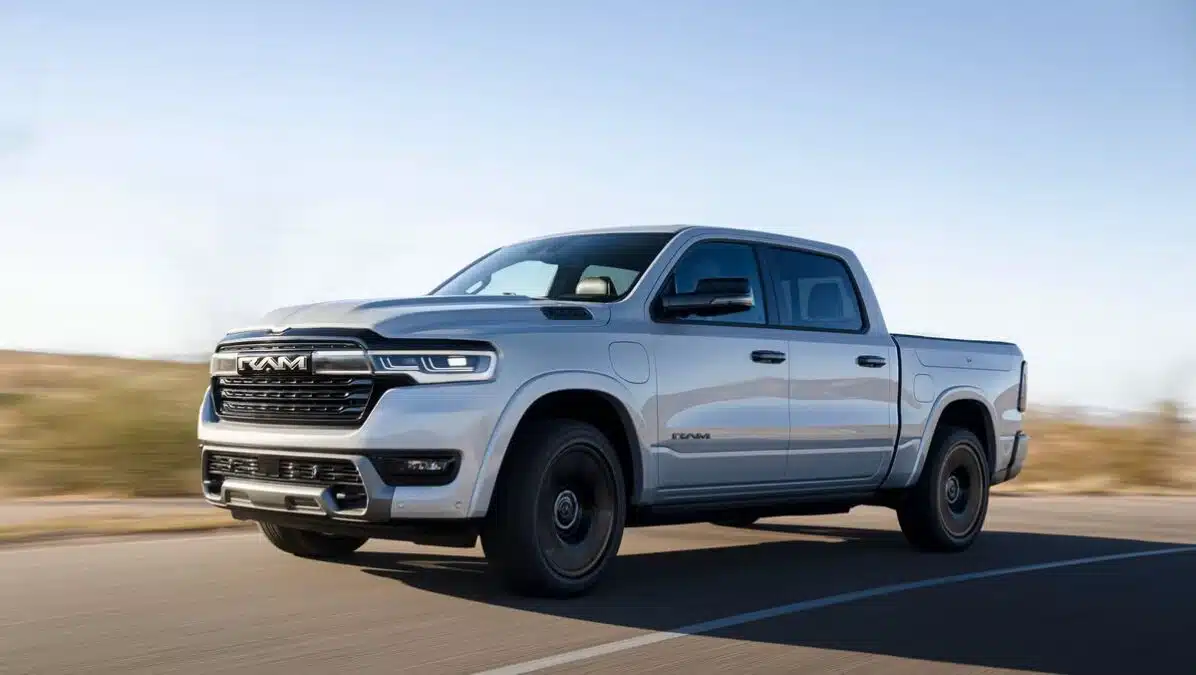
2026 Pickup Payload Chart
If you’re chasing the highest advertised payload for 2026, the heavy-duty trucks dominate (Ford Super Duty up to 8,000 lb).
For light-duty and EVs, the Tesla Cybertruck (up to 2,500 lb) and Ford F-150 (up to 2,440 lb) are among the headline numbers you’ll see published.
Before you use this chart (read this once)
Payload is not a “one-number” spec.
It changes materially with cab/bed, 4×2 vs 4×4, engine, battery pack (EVs), axle ratio, wheel/tire, and even options like sunroofs, skid plates, and premium interiors (all of which add curb weight and reduce payload).
Your real payload is the door-jamb sticker “Tire and Loading Information” value on your exact truck.
2026 Payload Chart (All Pickups): Max Published Payload
How to read: This table lists commonly published “max available” payload figures (or the highest trim/config figure the source provides).
Use it to compare models, then confirm your exact build on the door sticker or OEM guide.
| Segment | 2026 Pickup | Max published payload (lb) | Source / note |
|---|---|---|---|
| Heavy Duty | Ford Super Duty (F-250/350/450) | 8,000 | Ford “max available payload.” |
| Heavy Duty | Silverado 3500HD | 7,442 | “Strongest” 3500HD config. |
| Heavy Duty | Ram 3500 | 7,590 | Ram HD payload table (max entry). |
| Heavy Duty | Sierra 3500HD | 7,290 | GMC published max payload. |
| EV Pickup | Tesla Cybertruck | 2,500 | Varies by model/tire; max cited. |
| Half-ton | Sierra 1500 | 2,441 | GM Canada build/spec page shows higher max configs. |
| Half-ton | Ford F-150 | 2,440 | Ford published “max available” payload. |
| Half-ton | Ram 1500 | 2,360 | C/D cites max payload figure. |
| Half-ton | Silverado 1500 | 2,301 | GM Canada build/spec page. |
| EV Pickup | Rivian R1T (Gen 2) | 2,172 | Max varies by battery pack. |
| EV Pickup | Ford F-150 Lightning | 2,000 | Varies by battery; C/D summary. |
| Half-ton | Toyota Tundra | 1,940 | Toyota published max payload. |
| Midsize | Ford Ranger | 1,788 | Max payload cited (varies by engine). |
| Midsize | Toyota Tacoma | 1,710 | Max payload cited (varies by trim). |
| Midsize | Chevrolet Colorado | 1,570 | Edmunds spec listing. |
| Midsize | GMC Canyon | 1,570 | Edmunds spec listing. |
| Midsize | Jeep Gladiator | 1,725 | Payload varies by trim/equipment. |
| Compact | Ford Maverick | 1,500 | Ford published max payload. |
| Unibody | Honda Ridgeline | 1,583 | C/D cites max payload. |
| Unibody | Hyundai Santa Cruz | 1,411 | Hyundai “vehicle capacity weight.” |
| Midsize | Nissan Frontier | 1,400 | Nissan brochure lists max payload by config. |
Practical takeaways (what this chart really means)
1) Heavy-duty payload wins are configuration-driven
The biggest payload numbers usually come from regular cab + long bed + dually (where offered) + gas engine setups, because that combo often preserves more “available weight” for cargo.
If your use case is workbed payload (stone, salt, lumber), the HD segment is where you should start.
2) Half-ton “max payload” is real, but easier to lose than you think
A half-ton can publish 2,300–2,400 lb payload in certain configurations.
But the same model in a luxury trim with 4×4 and heavier options can drop sharply.
3) EV pickups split into “payload headline” vs “payload consistency”
Cybertruck’s published max payload figure can look excellent. Car and Driver
R1T’s max payload varies by battery pack, so you need to check the exact configuration you’re shopping.
Lightning payload varies by battery, too.
How to pick the right payload class in 60 seconds
If you routinely carry 2,000+ lb in the bed: Start with HD trucks.
That’s where payload stays high even after real-world add-ons.
If you only occasionally carry 1,200–1,800 lb: A midsize (Ranger/Tacoma/Colorado/Canyon) can do the job while staying easier to park and daily-drive.
If you mostly haul “homeowner stuff” under ~1,500 lb: Maverick / Santa Cruz / Ridgeline are often “enough truck” with better maneuverability.
FAQs
What’s the difference between payload and GVWR?
GVWR is the maximum the truck can weigh when loaded.
Payload is essentially GVWR minus curb weight, so every heavier option reduces payload.
That’s why “max payload” charts must be treated as configuration-specific.
Why do two sources show different payload numbers for the same truck?
They may be referencing different markets (U.S. vs Canada), different configurations, or different measurement contexts (a specific trim vs “max available” across the lineup).
That’s also why the door sticker is the only number that matters for your truck.
Does adding a tonneau cover or tool box reduce payload?
Yes.
Anything you bolt on counts as weight carried by the truck, reducing remaining capacity.
Does tongue weight count against payload?
Does tongue weight count against payload?
Yes.
Conventional trailer tongue weight (often ~10–15% of trailer weight) sits on the truck and consumes payload, along with passengers, cargo, and accessories.
What’s the fastest way to verify payload before buying?
Ask for a photo of the driver door-jamb Tire and Loading label on the exact VIN you’re buying.
If a seller can’t provide it, treat payload as unknown.
Conclusion
Use the chart above to narrow the field quickly.
Then validate payload on the door sticker for the exact configuration you’re buying, because options and drivetrains can move payload by hundreds (sometimes over 1,000) pounds.
Reminder: If this helped, like and comment with the truck you want added next and visit us again Truck Report Geeks.