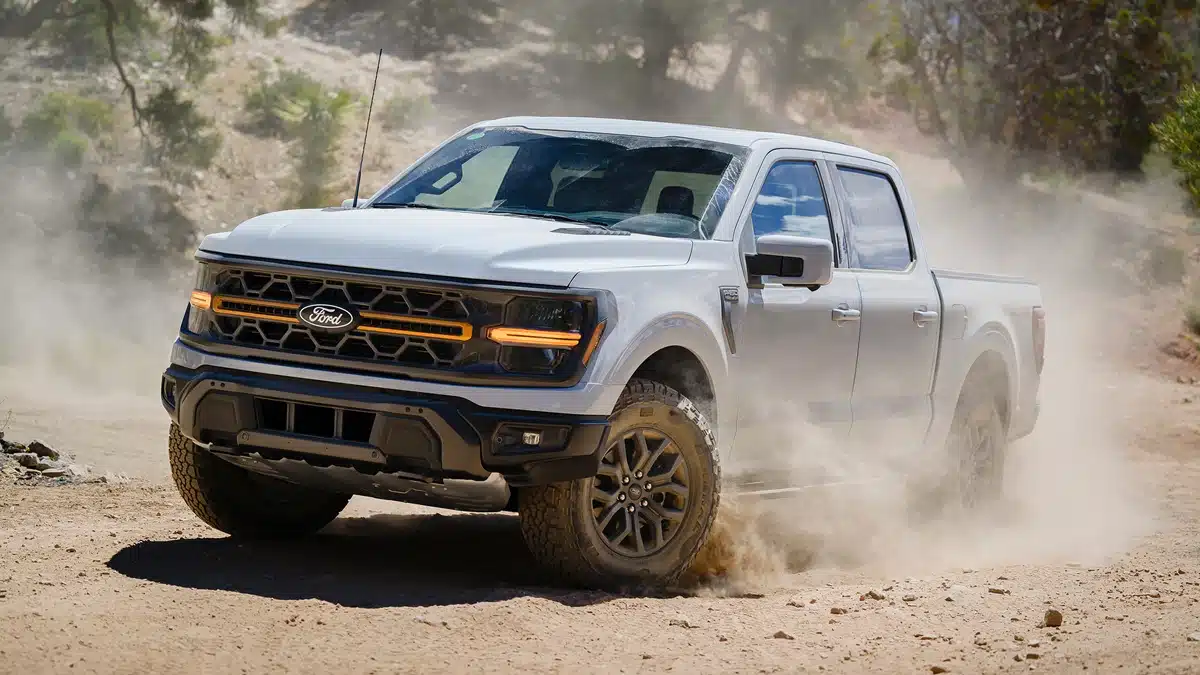
2026 Ford F-150 Engine Comparison
The 2026 Ford F-150 engine lineup is not “one size fits all.”
Ford is clearly segmenting powertrains by mission: value daily driving, max conventional towing, traditional V8 feel, hybrid torque plus exportable power, and high-performance off-road (Raptor / Raptor R).
The smart way to choose is to start with the constraint that matters most—towing, payload, fuel cost, or off-road durability—and then work backward into the engine and configuration that actually unlocks the number you think you’re buying.
Because with the F-150, published “maximums” are real, but only when you pair the right engine with the right cab/bed/axle/package combination.
Quick Comparison Chart (No Links)
| 2026 F-150 Engine | Horsepower | Torque (lb-ft) | Max Tow (lbs) | Max Payload (lbs) | Best For |
|---|---|---|---|---|---|
| 2.7L EcoBoost V6 | 325 | 400 | 8,400 | 1,775 | Best value daily + light towing |
| 3.5L EcoBoost V6 | 382 | 500 | 13,500 | 2,440 | Highest conventional towing |
| 5.0L Ti-VCT V8 | 400 | 410 | 12,900 | 2,225 | Traditional V8 feel + strong balance |
| 3.5L PowerBoost Hybrid | 420 | 578 | 11,600 | 1,750 | Torque + onboard power capability |
| 3.5L High-Output EcoBoost (Raptor) | 450 | 510 | 8,200 | 1,400 | High-speed off-road performance |
| 5.2L Supercharged V8 (Raptor R) | 720 | 640 | 8,700 | 1,400 | Peak performance and desert running |
How to Pick the Right Engine (The “No Regret” Framework)
If you follow one rule, follow this: payload is the limiter more often than horsepower.
Towing a heavy trailer doesn’t only demand torque.
It also consumes payload through tongue weight, passengers, tools, bed cargo, and accessories.
So the “best” engine is the one that fits your work pattern without forcing you into a payload math problem every weekend.
Use this decision ladder:
✅ Step 1 — Are you towing heavy (10,000+ lbs) regularly?
If yes, prioritize the engine and configuration that unlock max towing and max payload together, not just one.
✅ Step 2 — Do you need onboard power (tools, tailgating, emergency backup) often enough to matter?
If yes, the hybrid’s power export is a real functional advantage, not a talking point.
✅ Step 3 — Do you value traditional naturally aspirated driving feel and predictable power delivery?
If yes, you’re probably a 5.0L buyer, even if the spreadsheet says otherwise.
✅ Step 4 — Is this an off-road performance truck (Raptor / Raptor R) where suspension, tires, cooling, and durability define the purchase?
If yes, your “best engine” decision is really a “best Raptor” decision.
Engine-by-Engine Deep Dive
🧰 2.7L EcoBoost V6 (325 hp / 400 lb-ft)
This is the “do almost everything” value play.
It is designed to feel stronger than most people expect from the base turbo option, especially in everyday driving where midrange torque matters more than peak horsepower.
Capability snapshot
• Up to 8,400 lbs of towing (when properly configured).
• Up to 1,775 lbs of payload (when properly configured).
Who this engine is for
• Owners who commute and haul, but only tow occasionally.
• Buyers who want the lowest-cost engine that still feels legitimately truck-capable.
• People towing utility trailers, smaller campers, lightweight boats, and general weekend loads.
What it’s like to live with
This engine is usually the most rational choice if you do not tow heavy routinely.
It gives you meaningful capability while minimizing the “I paid for capacity I rarely use” problem.
Where owners get into trouble is assuming 8,400 lbs applies to their truck automatically.
In practice, tow rating is configuration-dependent, and payload is still the day-to-day constraint.
Practical recommendation
If you want the 2.7L, spec it as a daily driver first, then add towing equipment only if you truly need it.
Most regret with the 2.7L comes from people who bought it for “big towing someday” rather than for what they actually do weekly.
🏋️ 3.5L EcoBoost V6 (382 hp / 500 lb-ft)
This is Ford’s conventional towing headline engine for the mainstream F-150 lineup.
If your goal is the published maximum conventional tow number, this is the starting point.
Capability snapshot
• Up to 13,500 lbs of towing (when properly configured).
• Up to 2,440 lbs of payload (when properly configured).
Those are the big numbers, and they are why buyers cross-shop this engine so heavily.
Why it wins towing
Towing at the top end is less about “does the truck move it” and more about “does the truck manage it safely and confidently.”
The 3.5L EcoBoost is positioned to deliver strong torque where towing lives, and it is the engine associated with the maximum tow rating.
What most buyers underestimate
At high towing weights, your limiting factor may become:
• Tongue weight consuming payload.
• Passenger and cargo weight consuming payload.
• Bed accessories and aftermarket add-ons consuming payload.
• The package/axle ratio required to unlock the published maximum.
So yes, this is the max-tow engine path.
But the right configuration is what turns that potential into reality.
Who should choose it
• Travel trailer owners towing heavy most months of the year.
• Work users who regularly tow equipment, enclosed trailers, or multi-axle utility rigs.
• Buyers who want to future-proof towing capacity, even if they are not maxing it out weekly.
🧱 5.0L Ti-VCT V8 (400 hp / 410 lb-ft)
This is the traditionalist option, and it remains a serious capability choice.
It also tends to appeal to owners who want predictable throttle response and classic V8 character.
Capability snapshot
• Up to 12,900 lbs of towing (when properly configured).
• Up to 2,225 lbs of payload (when properly configured).
So it remains a “real towing engine,” not merely a nostalgia pick.
Why the 5.0L still makes sense
Many buyers simply prefer how a naturally aspirated V8 behaves:
• Linear throttle response.
• Familiar sound and driving feel.
• Strong, steady power delivery that does not depend on turbo spool behavior.
Where it fits best
• Buyers towing moderately heavy loads, but not chasing absolute maximum tow.
• Owners who haul often and want strong general performance without leaning into a hybrid system.
• People who want a truck that feels consistent across weather, altitude, and use cases.
The trade-off
If you are a pure spec-sheet shopper chasing the biggest headline tow number, the 3.5 EcoBoost usually wins that conversation.
But if your priority is the ownership experience and driving feel, the 5.0L is the “buy it once, enjoy it” choice for many.
🔋 3.5L PowerBoost Full Hybrid (420 hp / 578 lb-ft)
This powertrain exists for people who want torque-forward drivability plus functional power export.
If you use your truck as a tool—jobsite, camping, tailgating, emergency backup—this engine can be the most differentiated choice in the entire lineup.
Capability snapshot
• Up to 11,600 lbs of towing (when properly configured).
• Up to 1,750 lbs of payload (when properly configured).
• Available 7.2 kW exportable power capability depending on configuration.
Why buyers choose it
The PowerBoost isn’t only about MPG.
It’s about what torque plus electric assist feels like under load, and how the truck can supply power when you need it.
For a subset of owners, this replaces a generator or significantly reduces the need to carry one.
That is not a small convenience—it changes planning, work flow, and downtime.
The reality check on payload
Notice the payload number is lower than the max-payload figures attached to the 3.5 EcoBoost and 5.0L in Ford’s max charts.
That does not mean it is “bad.”
It means hybrid system weight and configuration trade-offs show up in the payload column, which matters if you routinely haul heavy bed loads and tow.
Who should buy it
• Buyers who tow moderately heavy but want the additional utility of onboard power.
• Drivers doing mixed city/highway mileage who value the hybrid’s real-world efficiency benefits.
• Owners who run tools, appliances, or accessories from the truck regularly.
Who should think twice
• If your primary mission is maximum payload with a heavy trailer tongue weight plus a full cab of passengers, you need to do the payload math carefully.
In that scenario, the 3.5 EcoBoost (max payload configuration) can be the safer “no surprise” pick.
🏜️ 3.5L High-Output EcoBoost (Raptor) (450 hp / 510 lb-ft)
This engine is a Raptor decision.
The Raptor is tuned for off-road performance and durability—suspension, tires, cooling, and stability at speed—not for maximum tow and payload numbers.
Capability snapshot
• Up to 8,200 lbs towing.
• Up to 1,400 lbs payload.
Why the towing numbers are lower
The truck is engineered around off-road performance.
That means different priorities: suspension travel, tire mass, gearing choices, and the overall package design.
So the right way to evaluate this engine is not “how does it compete with the 3.5 EcoBoost max tow,” but “does it deliver the Raptor experience I’m buying?”
Who it’s for
• Drivers who will use the truck off-road seriously.
• Buyers for whom performance and durability in harsh terrain matter more than tow/payload ceilings.
🧨 5.2L Supercharged V8 (Raptor R) (720 hp / 640 lb-ft)
This is the halo engine.
It is built for performance dominance, not maximum work-truck numbers.
Capability snapshot
• Up to 8,700 lbs towing.
• Up to 1,400 lbs payload.
The correct reason to buy it
You buy it because you want that engine and that level of performance, and you will use it.
If your primary mission is towing heavy or maximizing payload, the mainstream engines are the more rational tools.
Fuel Economy Expectations (What to Believe)
For 2026, fuel economy varies widely by engine, drivetrain (4×2 vs 4×4), tire package, and trim.
So the most useful way to think about MPG is as a range, not a single number.
Here is the practical summary that tends to hold true in real ownership:
• The 2.7L EcoBoost is typically the best “gas-only efficiency” option when configured sensibly.
• The PowerBoost can deliver excellent mileage in mixed driving while providing significant torque and power export utility.
• The 5.0L V8 generally trails the turbo options in efficiency but compensates with driving feel and strong broad capability.
• The Raptor and Raptor R prioritize performance; MPG is a secondary consideration.
The Two Numbers That Matter Most for Buyers
1) Payload: The silent limiter
Payload gets consumed by everything.
Passengers.
Bed cargo.
Toolboxes.
Aftermarket bumpers.
Tonneau covers.
Hitch hardware.
And most importantly—trailer tongue weight.
Even if you have “enough engine,” you can still exceed payload before you ever exceed tow rating.
That is why max payload figures are not trivia—they are central to selecting the right engine and configuration.
2) Tow rating: Only real when configured correctly
Every engine has a “max available” number, but it is conditional.
Axle ratio, tow package, hitch class, cab/bed configuration, 4×2 vs 4×4, and trim weight all move the final rating.
So the correct purchase mindset is:
“I’m buying the configuration that unlocks my required towing number,” not “I’m buying the engine and assuming the max.”
Fast Recommendations by Buyer Type
✅ Best engine for maximum conventional towing: 3.5L EcoBoost.
✅ Best engine for max payload potential: 3.5L EcoBoost (in the right payload-focused configuration).
✅ Best engine for value daily driving with real capability: 2.7L EcoBoost.
✅ Best engine for traditional feel with strong work capability: 5.0L V8.
✅ Best engine for torque + jobsite/tailgate power utility: PowerBoost hybrid.
✅ Best engine for serious off-road performance: Raptor HO 3.5 or Raptor R 5.2, depending on performance goals.
FAQs
Which 2026 F-150 engine is best for towing a travel trailer?
If your trailer is consistently heavy, the 3.5L EcoBoost is the most direct path to maximum conventional tow capability.
If you tow moderately heavy and also want onboard power for camping or gear, the PowerBoost becomes very compelling.
Is the PowerBoost worth it if I rarely use onboard power?
If exportable power is not valuable to you, then the PowerBoost decision becomes mostly about how you drive and whether the hybrid’s torque-forward feel and efficiency benefits justify the cost and payload trade-off.
For many buyers, it is still worth it—but it depends on how often you are in stop-and-go mixed driving versus steady highway miles.
Is the 2.7L EcoBoost “enough” for an F-150?
For most owners, yes.
It delivers meaningful torque and strong capability for typical homeowner and light commercial use.
The main reason to step up is if you tow heavy frequently or you want the most payload buffer possible.
Why do Raptor engines have lower tow and payload ratings?
Because those trucks are engineered around high-speed off-road performance.
Suspension, tire package, and overall design priorities differ from conventional towing builds.
What’s the single best way to avoid buying the wrong engine?
Decide your realistic trailer weight and typical passenger/cargo load first, then choose the engine and configuration that leaves you enough payload buffer while meeting towing needs.
Most regrets happen when buyers focus on horsepower and ignore payload math.
Sources
Truck buying guides, towing charts, and comparisons from TruckReportGeeks
Ford’s official 2026 F-150 page (engines, towing, payload)
Ford’s towing hub and towing resources
Car and Driver: 2026 Ford F-150 review, engine overview, MPG ranges
MotorTrend: 2026 Ford F-150 overview and powertrain summary
Conclusion
If you want the “most truck” for towing, the 3.5L EcoBoost is the cleanest path to Ford’s highest published conventional tow rating.
If you want torque-forward drivability and the option to power tools or gear from the truck, the PowerBoost is the most differentiated powertrain in the lineup.
If you want a balanced daily driver with real capability, the 2.7L EcoBoost remains the value pick, and if you want classic feel with strong capability, the 5.0L V8 is the traditionalist’s choice.
For more charts and truck-buyer decision guides, reference TruckReportGeeks.com truck research and towing guides.
If this helped, please like and comment with your exact trim (XL/XLT/Lariat/Platinum/Tremor/Raptor), drivetrain (4×2/4×4), and what you tow, and I’ll recommend the best engine configuration for your use case.