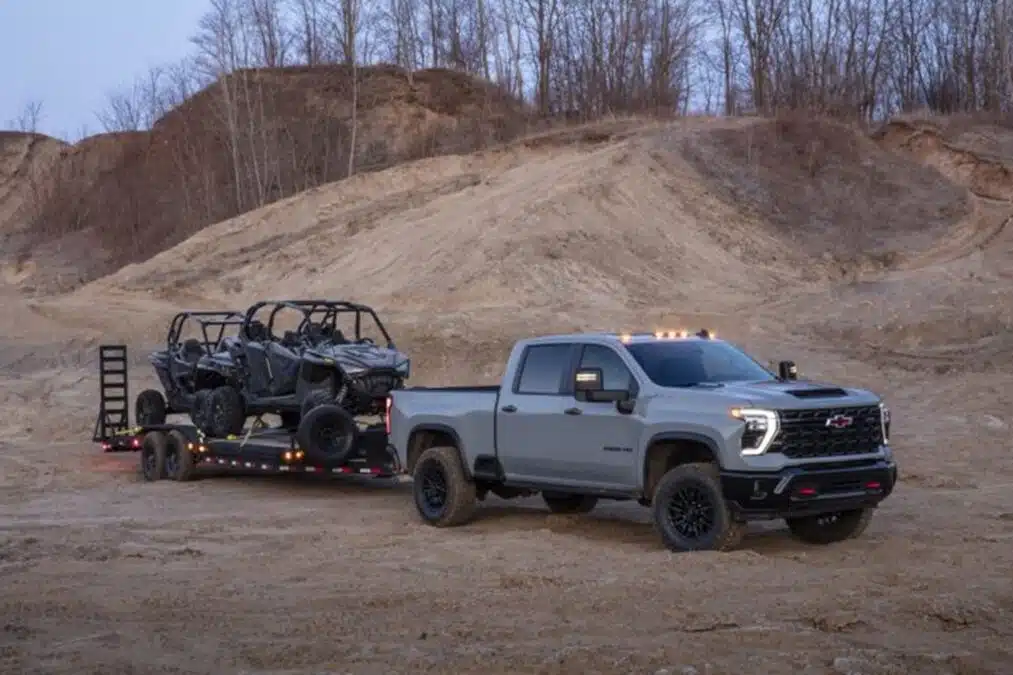
2026 HD Towing Chart
This is a 2026 model-year heavy-duty towing snapshot focused on “2500/3500 class” pickups.
That means Ram 2500/3500, Silverado 2500HD/3500HD, Sierra 2500HD/3500HD, and Ford Super Duty equivalents (F-250/F-350).
This chart shows maximum ratings.
Your exact rating can be lower depending on cab, bed, axle ratio, 2WD/4WD, tires, hitch type, payload left after options, and how the truck is equipped.
✅ 2026 HD Towing Chart (2500/3500 Trucks)
| Brand / Model (2026) | Class | Max Conventional (bumper-pull) | Max Gooseneck / 5th-Wheel | What usually “creates” the max |
|---|---|---|---|---|
| Ford Super Duty (F-250 equivalent) | 2500 | 22,000 | ~22,500 (configuration-dependent) | Right axle/engine combo, tow package, correct hitch rating |
| Ford Super Duty (F-350 equivalent) | 3500 | 25,000 (SRW) / 28,000 (DRW) | Can exceed 30,000+ on the right F-350 setup | DRW, diesel, high GCWR configuration |
| GMC Sierra 2500HD | 2500 | 22,390 | (varies by configuration; lower than 3500’s max) | Diesel + correct trailering equipment |
| GMC Sierra 3500HD | 3500 | 20,000 | 36,000 | Regular cab + proper equipment can reach the max |
| Chevy Silverado 2500HD | 2500 | (varies by body/engine; charted in OEM PDF) | 16,900 max (noted for certain equipment) | Engine + trim/package constraints matter a lot |
| Chevy Silverado 3500HD | 3500 | 20,000 (diesel configs) | Up to 43,500 (and 43,900 shown with Max Trailering Package, DRW) | DRW + diesel + Max Trailering Package |
| Ram 2500 | 2500 | (varies widely by engine/cab) | Peaks around the 20,000 range in many configs | Diesel/axle configuration and cab/bed choice matter |
| Ram 3500 | 3500 | (varies widely by engine/cab) | Up to 36,610 shown on the OEM tow/pay chart | DRW + High-Output diesel + best GCWR configuration |
🥇 Best gooseneck / 5th-wheel rating
If you’re searching “highest towing capacity 2026 3500,” you’re typically talking gooseneck / fifth-wheel.
On published max figures, the top end of the segment lands in the mid-30k to low-40k range depending on brand and equipment.
Takeaway: the best number is almost always a 3500 dually with the strongest diesel + the highest GCWR configuration.
🥈 Best max conventional (bumper-pull)
Conventional towing maxes are usually capped by rear suspension stability, hitch receiver limits, and payload/tongue weight realities.
Ford lists conventional maxes by Super Duty model family (including F-250 and F-350 variants).
GMC publishes Sierra HD conventional max figures on the model pages.
Chevrolet’s 3500HD chart shows conventional caps at 20,000 lb in the diesel sections.
Reality check: Most people who truly need 20k conventional should be asking whether their trailer is better moved to a gooseneck/5th-wheel for stability and payload management.
🧠 How to pick the right 2500 vs 3500 for your trailer
✅ Step 1: Identify your trailer type (this decides the “ceiling”)
Bumper-pull (conventional): more sensitive to tongue weight, sway, and receiver limits.
Gooseneck / fifth-wheel: usually unlocks the highest ratings, but pushes a lot of weight into the bed (pin weight), which hammers payload.
If your trailer is a big RV, car hauler, or equipment trailer, you’re often shopping “3500” before you realize you are.
✅ Step 2: Do the payload math (this is where most people get surprised)
A truck can have a monster tow rating and still be limited by payload.
Here’s why: with a gooseneck/5th-wheel, pin weight can be substantial, and you still have passengers, fuel, tools, bed cargo, and the hitch itself.
If you routinely travel with family + gear, a 2500 can run out of payload before it runs out of engine.
✅ Step 3: Decide SRW vs DRW based on stability, not ego
SRW (single rear wheel): easier daily driving, parking, and winter tire options.
DRW (dually): more rear tire footprint, better stability, and typically how the max tow numbers happen on 3500-class trucks.
If you’re shopping a fifth-wheel that’s long, tall, or heavy, DRW can be the “sleep better at night” decision even when SRW technically meets the rating.
✅ Step 4: Diesel vs gas (what matters for towing)
Diesel advantages: torque delivery under load, grade pulling, and often higher GCWR configurations.
Gas advantages: lower upfront cost, simpler maintenance for some owners, and strong performance for moderate towing.
At the very top of the towing charts, the max figures are commonly tied to diesel configurations.
🧰 Hitch + setup: the stuff that prevents “white knuckle towing”
🧷 Get the hitch class and hardware right
Receiver ratings vary by truck and trim.
If you’re anywhere near the top of the conventional chart, you need to be thinking about receiver limits, proper ball mount ratings, and whether a weight-distributing hitch is required/appropriate for your trailer.
🧯 Braking, tires, and load security are not optional
Stopping and stability are the real game at 15,000–20,000+ lb.
Your trailer brakes, brake controller tuning, and tire load ratings matter as much as the truck badge.
And if you’re hauling equipment or materials, securing the load is a safety and liability issue, not just a best practice.
If you want a quick safety refresher for cargo control, here’s the official guidance: NHTSA load securement tips.
📏 Why tow ratings can be compared (SAE J2807)
A lot of modern tow ratings are developed under SAE J2807 test procedures, which create a more consistent way to publish GCWR and trailer weight ratings across vehicles.
If you want to understand the standard behind many OEM tow numbers, here’s the standard listing: SAE J2807 standard overview.
🧾 The “best match” cheat sheet (common buyer scenarios)
🚤 Boats and medium equipment (often 8k–14k loaded)
A 2500 can be perfect if payload works for your passengers + tongue weight.
If you tow frequently or in mountains, consider diesel for relaxed pulling.
🏕️ Fifth-wheel RVs (often where 3500 makes sense fast)
If your fifth-wheel is large, your pin weight can climb quickly.
That’s where 3500 (and often DRW) stops being “overkill” and starts being “properly matched.”
🚜 Heavy construction trailers / hotshot-style needs
If you’re truly shopping the highest numbers, you’re usually in 3500 DRW territory with the correct tow prep and GCWR configuration.
This is also where you should treat your truck choice like a system: truck + hitch + trailer brakes + tires + load strategy.
❓ FAQs
What’s the best 2026 heavy-duty truck for towing?
The best towing truck is the one that meets your trailer’s needs with margin on payload and stability.
If your trailer is a heavy fifth-wheel/gooseneck, a 3500 DRW setup is commonly the correct direction based on how max ratings are achieved
Is a 2500 “enough” for a fifth-wheel?
Sometimes, yes.
But many fifth-wheel owners hit payload limits (pin weight + passengers + cargo) before they hit the advertised tow rating.
Why do I see different max numbers for the “same” truck online?
Because cab, bed length, drivetrain, axle ratio, wheels/tires, and options all change the rating.
That’s why OEM tow guides and charts exist.
Use these official charts to verify your exact configuration:
What’s the easiest “upgrade” that improves towing confidence?
For bumper-pull towing: correct hitch setup, correct tongue weight balance, trailer brake tuning, and tires rated for the load.
For gooseneck/5th-wheel towing: choosing the right truck class (often 3500), then dialing in payload and stability.
Final thoughts
If you want the least regret purchase, don’t shop tow rating first.
Shop trailer type → loaded trailer weight → payload math → stability (SRW vs DRW) → engine choice.
That’s how you end up with a truck that tows confidently instead of a truck that only “wins on paper.”
👍 If this helped, like and comment with what you’re towing (bumper pull, gooseneck, or fifth-wheel) and the approximate loaded weight—I’ll point you to the smartest 2500 vs 3500 direction.