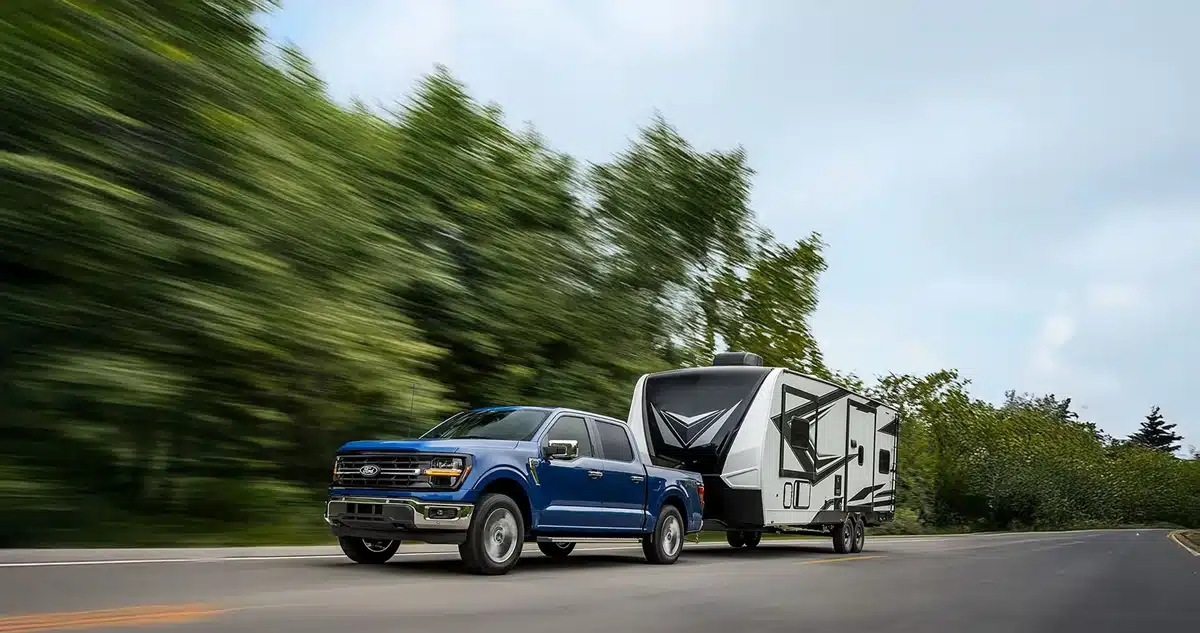
2026 F-150 Towing by Engine and Axle Ratio
Most “towing confusion” on the 2026 F-150 comes from one simple fact: Ford’s tow limits are published by engine, axle ratio, cab/bed, drivetrain, and equipment, not by trim alone.
That means two trucks that both say “3.5 EcoBoost” can have different maximum loaded trailer weights if one is geared and packaged for towing and the other is not.
To make this actionable, this article gives you (1) a fast engine-by-engine towing map, (2) a simple axle ratio decision framework, and (3) a spec checklist you can use while shopping listings.
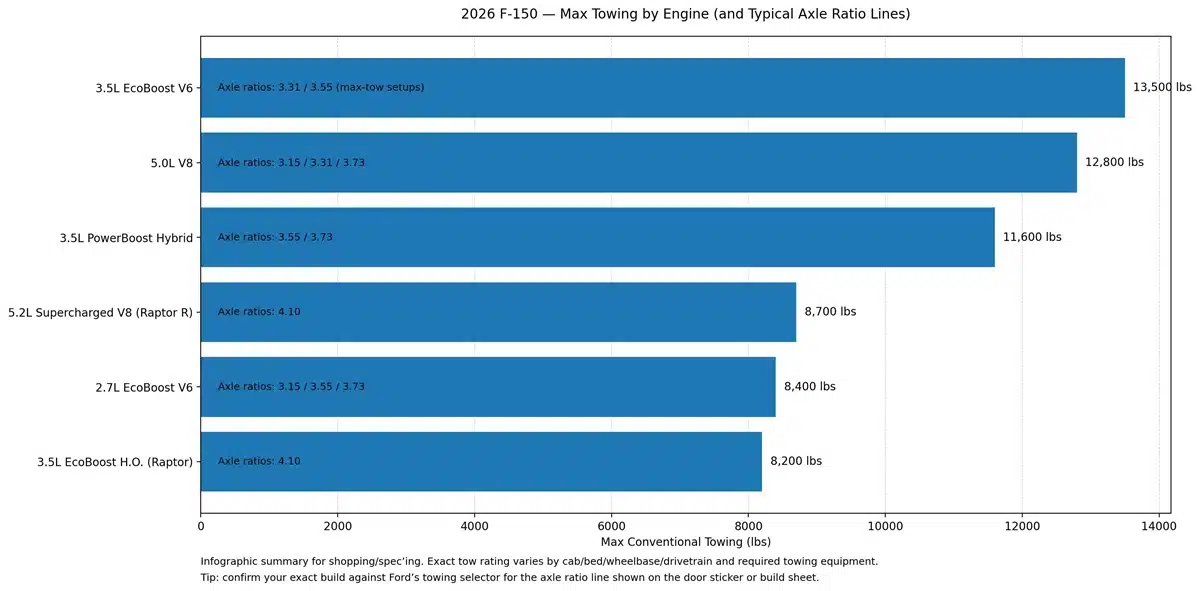
Quick “maximum tow” map by engine
Ford’s 2026 F-150 page publishes max available tow ratings by engine, and also shows that tow ratings vary across axle ratios within the towing selector tables (example: 2.7L rows appear with axle ratios like 3.15/3.55 and 3.73, with different GCWR and trailer-weight limits).
Here is the practical takeaway you can shop by:
- ✅ 2.7L EcoBoost: best for light-to-mid trailers when geared appropriately.
- ✅ 3.5L EcoBoost: the top “max tow” path in the lineup.
- ✅ 3.5L PowerBoost hybrid: strong tow ratings with a daily-driver efficiency angle.
- ✅ 5.0L V8: excellent capability when you match the axle ratio and towing equipment to the trailer.
Comparison table (use this to spec your truck)
Use the table below as a shopping filter.
Then confirm your exact cab/bed/drivetrain line in the official towing selector before you buy.
| Engine | Best fit for (loaded trailer) | Axle ratio strategy | What to avoid |
|---|---|---|---|
| 2.7L EcoBoost | ~3,000–8,400 lb | Prioritize the axle ratio that appears on the higher-rated towing selector line for your cab/bed | Buying “any” 2.7 and assuming it will match the max rating |
| 3.5L EcoBoost | ~6,000–13,500 lb | If you want big numbers, shop listings that include tow equipment and the “max tow” axle path | A “nice trim” with a towing-light axle/setup |
| 3.5L PowerBoost | ~5,000–11,600 lb | If you tow often, look for the higher-rated axle ratio lines and the right package notes | Treating hybrid as “just MPG” and forgetting payload math |
| 5.0L V8 | ~5,000–12,800 lb | Look for axle ratio lines tied to higher GCWR and max trailer weights for your wheelbase | Assuming the V8 automatically equals max tow |
What axle ratio changes (and why it matters for towing)
⚙️ Axle ratio is torque multiplication at the rear wheels.
A numerically higher ratio (example: 3.73 vs 3.15) generally helps the truck feel more confident getting a heavy trailer moving, holding gears on hills, and reducing “lugging.”
From a ratings perspective, Ford’s towing selector structure makes the point clearly: the same engine appears on multiple rows with different axle ratios, different GCWR, and different maximum loaded trailer weights.
Practical guidance:
- ✅ If your trailer is heavy or you tow in hilly terrain, you typically want the axle ratio that shows up on the higher-rated towing selector lines for your configuration.
- ✅ If you tow light and prioritize daily driving economy, a “taller” axle ratio can be fine—provided it still covers your real loaded trailer weight with margin.
The packages that unlock the top towing numbers
📌 If you are shopping for the higher tow ratings (especially in the 10,000+ lb range), you should expect to see Ford call out required towing equipment.
In Ford’s towing guide, higher-capability setups are repeatedly tied to Tow/Haul Package (53T) and an optional Max Tow Axle in the notes, and the guide also highlights equipment requirements once you cross certain trailer-weight thresholds. Ford VDM
In shopping terms, this means:
- ✅ Do not spec “engine only.”
- ✅ Spec engine + axle ratio line + Tow/Haul/Max Tow notes.
Engine-by-engine: how to pick the right axle ratio for your trailer
✅ 2.7L EcoBoost: best value for lighter conventional towing
If you tow occasionally and your loaded trailer is typically below the mid-range, the 2.7L can be a strong “real-world” choice.
Where buyers go wrong is assuming every 2.7L listing carries the same tow ceiling.
Your best move is to shop 2.7L listings by axle ratio line (and the rest of the configuration) first, then confirm the maximum loaded trailer weight that matches that line.
Best-fit use cases:
- Smaller travel trailers.
- Utility trailers.
- Smaller boats.
- “Weekend tow” owners who still want a comfortable daily driver.
✅ 3.5L EcoBoost: the max conventional tow path
If your goal is to pull heavier travel trailers, equipment trailers, or a larger car hauler, the 3.5L EcoBoost is typically the straightest path to the top published conventional tow rating.
But again: the rating is not “automatic.”
To reach the big number, you shop for the correct axle ratio row and the towing equipment notes that go with it.
Best-fit use cases:
- Heavy travel trailers (properly equipped).
- Equipment trailers.
- Frequent towing where hill performance matters.
✅ 3.5L PowerBoost hybrid: strong tow ratings for “tow often” owners
The hybrid is not just about fuel economy.
If you tow regularly and you want a truck that remains pleasant when it’s not hitched to a trailer, the PowerBoost can be a very practical balance—so long as you still shop it like a tow vehicle (axle ratio row, package notes, and payload math).
Best-fit use cases:
- Frequent towing.
- Mixed driving (commute + towing).
- Owners who want strong torque delivery and modern trailering tech.
✅ 5.0L V8: classic towing feel, still configuration-dependent
The V8 is an excellent towing engine in the F-150 lineup, but it still follows the same “selector-table reality” as the turbo engines.
You will see multiple axle ratio lines tied to different GCWR and different maximum loaded trailer weights.
So the right way to shop the V8 is the same: match your trailer weight to the correct axle ratio row, then confirm the rest of the build.
Best-fit use cases:
- Owners who want V8 driving behavior.
- Mid-to-heavy towing, properly equipped.
- Mixed work + towing schedules.
The limits that cap you before the engine does
This is where most “I should be able to tow X” conversations go sideways.
⚠️ Hitch setup rule (do not skip)
Ford states: do not exceed 5,000 lbs when towing without a weight-distribution system.
⚖️ Payload and tongue weight math
Ford also notes: trailer tongue load should be about 10% of total loaded trailer weight, and your available payload must accommodate that tongue load plus passengers and cargo.
🧮 GCWR ceiling
Finally, Ford notes the combined weight of vehicle and trailer cannot exceed listed GCWR, and you should not exceed the maximum loaded trailer weight shown in the selector.
Why this matters: a truck can be “rated” to tow a big trailer, yet your specific day-to-day setup (family in the cab, gear in the bed, toolboxes, hitch hardware) can push you into payload or combined-weight limits first.
How to shop listings without wasting time
Use this quick checklist when you are scanning dealer inventory.
✅ Step 1: Start with your real trailer weight.
Use loaded weight, not brochure “dry weight.”
✅ Step 2: Choose the engine based on your towing band.
Light-to-mid: 2.7L.
Mid-to-heavy: PowerBoost or 5.0L.
Max conventional: 3.5L EcoBoost.
✅ Step 3: Filter by axle ratio and towing package notes.
If the listing is missing axle ratio or tow package details, treat it as incomplete until the dealer confirms it.
✅ Step 4: Confirm the exact selector-table row.
Cab/bed/wheelbase/drivetrain changes the line you land on.
Towing drivability: what Tow/Haul actually does for you
Tow/Haul is not marketing fluff if you tow in real terrain.
Ford’s towing guide notes that using tow/haul mode can help eliminate unwanted gear hunting on grades and help control speed on downhill sections by managing shifts more intelligently. Ford VDM
The practical benefit is less transmission “searching,” steadier engine braking, and a more settled towing feel—especially in rolling hills.
FAQs
Does axle ratio change 2026 F-150 towing capacity?
Yes.
It changes which towing selector row your truck falls under, which changes GCWR and the maximum loaded trailer weight.
What is the “best” axle ratio for towing on a 2026 F-150?
The best axle ratio is the one attached to the towing selector line that covers your real loaded trailer weight with margin, for your specific cab/bed/drivetrain.
If you tow heavy or in hills, the higher-rated towing axle lines are usually the right direction.
Can I tow over 5,000 lbs without a weight distribution hitch?
Not per Ford’s towing guide.
If you plan to tow over 5,000 lbs, you should plan on a proper weight-distribution setup and confirm your full towing equipment.
What matters more: engine or axle ratio?
For rating and drivability, it’s the combination.
Engine determines the ceiling, axle ratio and equipment determine which published line you actually qualify for.
Conclusion
If you want to spec a 2026 F-150 the right way, start with your trailer’s loaded weight, choose the engine that covers that weight class, then shop listings by axle ratio and towing package notes, not by trim badges.
Do that—and you avoid the most common buyer mistake: purchasing the right engine in the wrong configuration.
If this helped, please like and comment with your trailer’s loaded weight, your typical terrain (flat vs hills), and whether you’re shopping SuperCrew 5.5′ or 6.5’—and I’ll tell you the most sensible engine + axle ratio target for your use case.
Get the 3.5L EcoBoost with the 3.55 axle ratio.
That is the best middle-ground setup for most buyers in your situation. Ford’s current towing guide shows the 3.5L EcoBoost is the strongest mainstream F-150 towing engine, and Ford still rates the F-150 as high as 13,500 lbs max towing in the right configuration. In the SuperCrew/short-bed configs, the 3.5 EcoBoost materially out-tows the 2.7, while keeping much better everyday drivability than going to a Super Duty.
Great article. Shopping for a new truck. Pulling a 20 foot aluminum boat package loaded weight approximately 5500 pounds, most flat terrain, towing approximately 25,000 miles per year. Looking at a supercrew cab with 5.5 foot box. Not sure best engine and axle ratio. The truck is also my daily driver to work. Thanks