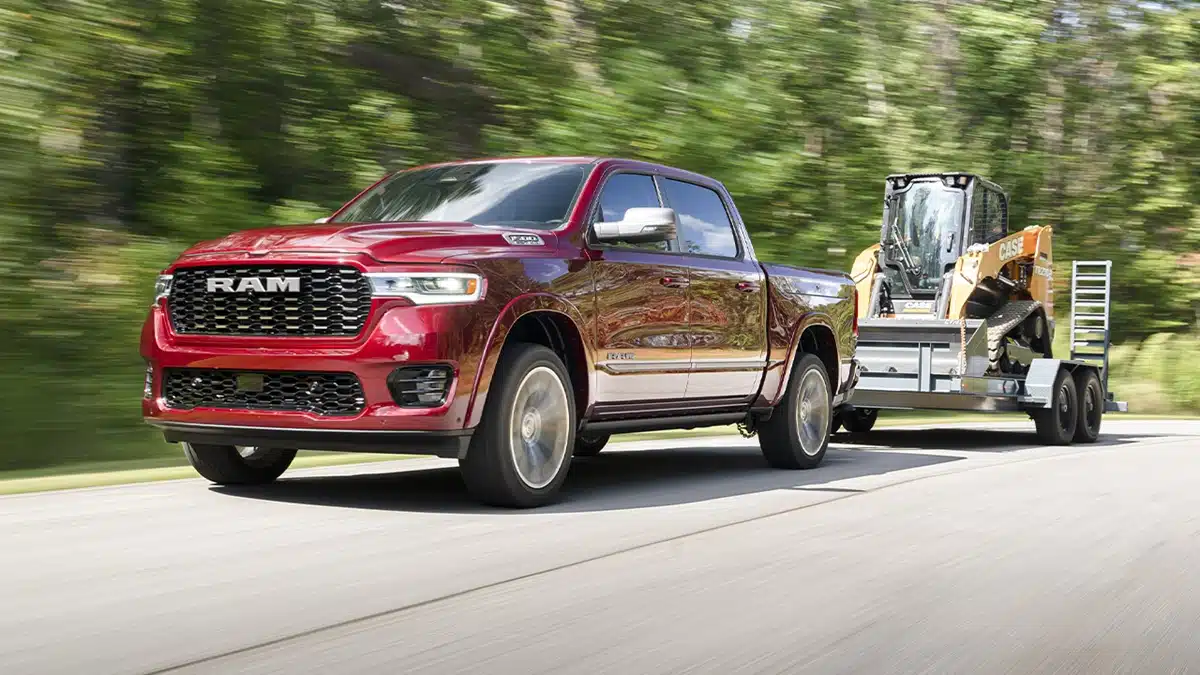
2026 Ram 1500 Towing by Engine and Axle Ratio
Two Ram 1500s can have the same engine and still tow very different amounts.
The most common reason is axle ratio, because it changes how much mechanical advantage the truck has at the wheels and how the truck is certified for GCWR (gross combined weight rating).
Ram’s official payload and towing sheet shows towing capacities and GCWR by engine + axle ratio, and it also includes the guardrails that matter (tongue weight assumptions, GCWR/GVWR/GAWR limits, and weight-distributing recommendations).
If you’re building a buyer’s guide that actually helps people, the clean way to explain it is:
- Engine picks your power band.
- Axle ratio sets how effectively that power moves a load (and what the truck is rated to pull).
- Payload and tongue weight decide whether you can use that tow rating in the real world.
✅ Quick takeaways (what most readers want first)
- Highest max tow for 2026 Ram 1500 (gas lineup): up to 11,610 lbs when properly equipped.
- That highest rating is tied to the 3.0L twin-turbo Hurricane (SO) with the 3.92 axle in specific 4×2 configurations shown on Ram’s tow sheet.
- 3.92 is the “towing axle.” It is where you see the largest GCWRs (for example, 17,000 GCWR appears in the 3.92 rows on the official sheet).
- The 5.7L HEMI V8 returns for 2026 and is shown with up to 11,320 lbs max towing on Ram’s official tow sheet.
📊 Comparison table (best-case tow ratings by engine and axle ratio)
The numbers below are pulled directly from Ram’s 2026 Ram 1500 Payload & Towing Weight Capacities sheet (SAE J2807-compliant).
These are maximum trailer weight capacities and can vary by cab/bed and 4×2 vs 4×4, so treat them as best-case ceilings for each engine/axle combo
| Engine (2026 Ram 1500)Axle ratioWhat this axle ratio typically signalsBest-case max tow shown on Ram’s sheet | |||
|---|---|---|---|
| 3.6L Pentastar V6 eTorque | 3.21 | Economy/neutral gearing | Up to 6,570 lbs (crew 4×2 example), with other configs shown lower. |
| 3.6L Pentastar V6 eTorque | 3.55 | “Workable middle” gearing | Up to 8,130 lbs (Quad Cab 4×2 max called out). |
| 5.7L HEMI V8 eTorque | 3.21 | V8 available without the tow axle | Up to 8,220 lbs (crew 4×2 example). |
| 5.7L HEMI V8 eTorque | 3.92 | Tow-focused gearing | Up to 11,320 lbs (crew 4×2 example). |
| 3.0L Hurricane I6 (SO) twin-turbo | 3.21 | Strong engine, non-tow axle | Up to 8,510 lbs (Quad Cab 4×2 example). |
| 3.0L Hurricane I6 (SO) twin-turbo | 3.55 | Strong engine, mid gearing | Up to 8,270 lbs (4×4 example shown). |
| 3.0L Hurricane I6 (SO) twin-turbo | 3.92 | Tow-focused gearing + higher GCWR | Up to 11,610 lbs (Quad Cab 4×2 example). |
| 3.0L Hurricane I6 (H/O) twin-turbo | 3.92 | Performance-oriented output, still tow-capable | Up to 10,000 lbs shown (Limited example), with other H/O trims shown lower. |
Engine-by-engine: what to pick, and why axle ratio changes everything
1) 3.6L Pentastar V6 eTorque: best for light trailers and value builds
The Pentastar eTorque is the entry towing engine in the 2026 lineup.
On the official sheet, its towing rows are shown under 3.21 and 3.55 axle ratios, with the highest V6 max towing called out as 8,130 lbs (Quad Cab 4×2).
How to spec it for towing:
- If you tow occasionally (small boat, utility trailer, jetskis), the V6 can be fine.
- If you tow frequently, the V6 is much more compelling when paired to the higher of its listed axle setups (the V6’s max tow callout is associated with the higher towing configuration on the sheet).
Who should buy it:
- Buyers towing under roughly the midrange of half-ton trailers who care about purchase price more than maximum tow ceiling.
- Anyone who wants a Ram 1500 primarily as a daily driver, and towing is secondary.
2) 5.7L HEMI V8 eTorque: classic towing feel, but axle ratio is the whole story
Ram’s official 2026 capability page notes the HEMI is back on select models.
On the official towing sheet, the HEMI’s max tow is shown as up to 11,320 lbs (best-case configuration listed).
Here is the key point for your readers:
A HEMI with a non-tow axle can look surprisingly “average” on paper, while the HEMI with the tow axle becomes a legitimate heavy-puller.
What the sheet shows (in plain English):
- With 3.21, the HEMI row includes an example tow number of 8,220 lbs in a Crew Cab 4×2 configuration.
- With 3.92, the HEMI row includes an example tow number of 11,320 lbs (best-case configuration shown).
That is the difference between “comfortable boat and utility trailer duty” and “legit RV and equipment trailer territory,” assuming you have payload margin.
3) 3.0L Hurricane I6 (SO): the max-tow mainstream engine
The official 2026 towing sheet shows the 3.0L Hurricane (SO) with three axle ratios listed: 3.21, 3.55, and 3.92.
This is the powertrain where the sheet displays the highest max tow in the standard gas lineup: 11,610 lbs in a 3.92 axle configuration.
If you want one sentence that helps people shop correctly:
If the trailer is heavy, Hurricane + 3.92 is the configuration that unlocks the big tow number.
What the sheet shows by axle:
- 3.21 axle: up to 8,510 lbs shown (Quad Cab 4×2 example).
- 3.55 axle: up to 8,270 lbs shown (4×4 example).
- 3.92 axle: up to 11,610 lbs shown, with 17,000 GCWR listed on that row.
That is why axle ratio matters more than people think.
With the same engine, you can be looking at “8k-ish” or “11k-plus,” depending on how the truck is geared and certified. ramtrucks
4) 3.0L Hurricane I6 (H/O): performance-first, still tow-capable
The official sheet lists the Hurricane H/O under 3.92 axle ratio, but it shows different towing figures depending on trim applications (for example, entries labeled RHO and Limited).
On that sheet, the H/O max towing shown reaches 10,000 lbs for a Limited example, while other H/O trim entries are shown lower.
For buyer guidance:
- If the shopper is choosing H/O because they want the highest-output driving experience, towing is still viable.
- If the shopper’s primary goal is maximum towing, the non-H/O Hurricane (SO) with 3.92 is the lineup’s max tow configuration shown on the sheet.
Axle ratios explained: 3.21 vs 3.55 vs 3.92 (simple, accurate, useful)
✅ 3.21 axle ratio
3.21 is typically the “tallest” gearing of the three.
It generally favors lower cruising RPM and everyday drivability, but it tends to produce lower tow ratings on paper versus 3.92.
In the Ram 1500 towing sheet, 3.21 rows for multiple engines show lower maximum trailer capacities than their 3.92 counterparts.
✅ 3.55 axle ratio
3.55 is the middle ground.
It is commonly selected when buyers want a better towing feel than 3.21 without fully committing to the tow axle, but on the sheet it still does not unlock the highest GCWR/max tow numbers the 3.92 rows show.
✅ 3.92 axle ratio
3.92 is the towing axle.
On the official sheet, this is where you see the highest GCWR entries (including 17,000 GCWR for the Hurricane SO + 3.92 row).
This is also where the sheet shows the top tow numbers:
- 11,610 lbs for Hurricane SO.
- 11,320 lbs for HEMI.
If a buyer is shopping to a trailer weight number, this is the axle ratio you want them to look for first.
The “real math” that limits towing before you hit the brochure number
Ram’s towing sheet includes the disclaimers most shoppers skip, and those disclaimers are exactly where safe towing lives.
Here are the key ones to translate for your audience:
- Trailer weight and payload ratings are mutually exclusive.
- GAWR, GVWR, and GCWR should never be exceeded.
- The chart’s conventional hitch tongue weight is calculated as 10%.
- A weight-distributing system is recommended for trailers over 5,000 lbs.
- Trailer weight capacities shown include a 300-lb passenger weight assumption.
What this means in practice
If your reader buys a truck rated to tow 11,610 lbs, they do not automatically get to hook up an 11,500-lb travel trailer and load the cab with five people and gear.
They have to stay under:
- The truck’s payload limit (because tongue weight consumes payload quickly).
- The truck’s axle ratings (rear axle loading is often the first constraint).
- The truck + trailer’s GCWR.
This is why “best engine” content that ignores axle ratio and payload is incomplete.
“Best setup” recommendations by trailer type
🛶 Boats and utility trailers (light to moderate)
If the reader is towing:
- Small boats.
- Jet skis.
- Utility trailers with lawn equipment.
A V6 or HEMI with a non-tow axle can still work, depending on trailer weight and how frequently they tow.
If they tow every weekend, you still steer them to the more tow-focused combos for stability and less drivetrain strain.
🏕️ Travel trailers (RVs)
For travel trailers, you should guide buyers away from shopping only by max tow.
The better decision framework is:
- Get the axle ratio and engine that deliver the tow rating you need.
- Then ensure your payload is high enough for tongue weight plus passengers plus cargo.
In the 2026 lineup, the sheet clearly indicates the strongest “traditional” towing configuration is the 3.0L Hurricane (SO) + 3.92 axle, shown up to 11,610 lbs in best-case form.
🧰 Work trailers and equipment
If the trailer is heavy and used frequently, the buyer should prioritize:
- The tow axle (3.92).
- The powertrain that is shown with the highest max towing in the sheet (Hurricane SO).
Then you coach them to confirm:
- Trailer brake controller and proper braking setup.
- Weight distribution (especially above 5,000 lbs, per Ram’s recommendation).
- Ram: 2026 Ram 1500 Capability (max tow and model capability overview) ramtrucks
- Ram: 2026 Ram 1500 Payload & Towing Weight Capacities (official PDF) ramtrucks
- Ram: Towing Capacity Guide hub (select 2026 and Ram 1500) ramtrucks
❓ FAQs
What is the maximum towing capacity of the 2026 Ram 1500?
Ram lists maximum towing capacity up to 11,610 lbs when properly equipped
Which 2026 Ram 1500 engine tows the most?
On Ram’s official 2026 payload/towing sheet, the 3.0L Hurricane (SO) twin-turbo I6 paired with the 3.92 axle is the combination that shows the top tow number (11,610 lbs) in best-case form.
Does 3.92 always tow more than 3.21 or 3.55?
In the official 2026 tow sheet, the highest tow ratings for the Hurricane SO and HEMI appear under 3.92, and 3.92 rows also show higher GCWR values (such as 17,000 GCWR in the Hurricane SO row).
Do payload and towing ratings affect each other?
Yes.
Ram explicitly states that trailer weight and payload ratings are mutually exclusive, and that GVWR/GAWR/GCWR should not be exceeded.
When should you use a weight-distributing hitch?
Ram’s tow sheet recommends a weight-distributing system for trailers over 5,000 lbs.
Conclusion
If you want the most straightforward buyer guidance for the 2026 Ram 1500:
- For maximum towing: 3.0L Hurricane (SO) + 3.92 axle (the sheet’s best-case max tow configuration).
- For V8 towing feel: 5.7L HEMI + 3.92 axle (best-case towing shown at 11,320 lbs).
- For value/light towing: 3.6L V6 eTorque, ideally in the higher-tow configuration if the trailer weight is pushing your comfort zone.
Then, regardless of engine, the safest final step is always the same:
Confirm your exact truck’s ratings and keep payload, axle limits, and GCWR in-bounds, because those constraints are what determine whether towing feels stable and controlled.
Reminder: Like and comment with your trailer type (RV, boat, equipment), estimated loaded trailer weight, and whether you’re shopping 4×2 or 4×4.
I’ll tell you which engine + axle ratio is the best fit and which limit (payload, tongue weight, or GCWR) will likely cap you first, and visit us again Truck Report Geeks