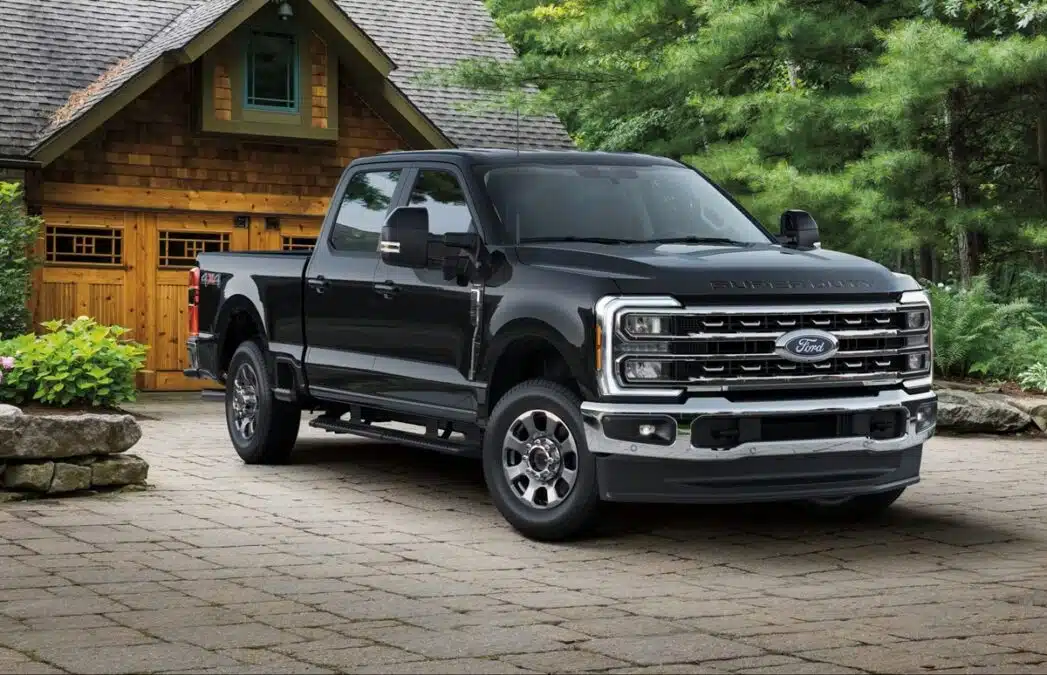
2026 Super Duty Bed Sizes
If you tow a gooseneck/5th-wheel often and want the simplest, least-compromised setup, the 8′ bed is usually the safer pick.
If you tow bumper-pull/conventional trailers and also need the truck to be easier to park, turn, and live with daily, the 6.75′ bed is often the better balance.
2026 Super Duty Bed Size Options
Ford’s pickup bed offerings for 2026 Super Duty center on two mainstream cargo box lengths: 6.75 ft and 8 ft, with measurable differences in usable floor length and cargo volume.
Comparison Table (Bed Sizes at a Glance)
| Bed option | Common label | Bed length (floor) | Bed length (top) | Cargo volume |
|---|---|---|---|---|
| 6.75′ bed | “Short bed” | 81.9 in | 80.3 in | 65.4 cu ft |
| 8′ bed | “Long bed” | 98.1 in | 96.4 in | 78.5 cu ft |
Why Bed Length Matters for Towing (Not Just “Cargo”)
Bed size is really a proxy for how you will use the truck during towing season.
It affects wheelbase behavior, hitch clearance, where you can place payload, and how much “stuff” you can carry in the bed while towing without creating conflicts (toolboxes, auxiliary tanks, generators, bed caps, slide-in campers, etc.).
And it influences how you’ll feel on the road: stability at speed versus maneuverability in tight spaces.
Towing Pros and Cons of the 6.75′ Bed
✅ Pros (Why the 6.75′ bed works for many towers)
Easier maneuvering.
Shorter overall length generally improves daily drivability—parking, tight job sites, urban turns, and backing into smaller driveways.
Often a better “do-everything” compromise.
If your towing is mostly conventional (bumper-pull) and you want a truck that still feels manageable when it’s not hooked up, the 6.75′ bed is typically the sweet spot.
Better fit for mixed-use builds.
Many owners run a bed cover, drawers, or modular cargo systems that are easier to live with on the shorter bed, while still keeping room for gear.
⚠️ Cons (Where the 6.75′ bed can complicate towing)
5th-wheel/gooseneck clearance can be more finicky.
Shorter beds can increase the chance of cab-to-trailer contact on tight turns, depending on trailer geometry and hitch setup.
This is solvable (slider hitches, offset/extended pin boxes, careful spec matching), but it’s one more variable.
Less “conflict-free” bed space while towing.
If you want a large toolbox plus a bed-mounted hitch plus additional cargo, you run out of real estate sooner.
That matters most for RVers and contractors who tow and haul simultaneously.
Towing Pros and Cons of the 8′ Bed
✅ Pros (Why the 8′ bed is the towing-first pick)
Simpler, cleaner gooseneck/5th-wheel ownership.
Long beds are the traditional choice for bed-mounted towing because they give you more room to position equipment and maintain safer clearance margins—especially during uneven terrain and tight backing maneuvers.
More usable bed space while towing.
The long bed’s added floor length and higher cargo volume make it easier to carry work gear, generators, tie-down loads, or an auxiliary fuel tank without constantly re-arranging around the hitch.
Better “towing feel” for many drivers.
In practice, a longer wheelbase often contributes to a more settled feel at highway speeds with heavier trailers, particularly in crosswinds and during lane changes.
⚠️ Cons (Tradeoffs you feel every day)
Harder to park and pivot.
If this is also your daily driver, you will notice the turning and parking burden.
Job sites, downtown lots, and drive-thrus become more planning-intensive.
More truck to manage when backing into tight spots.
Yes, long-bed towing can be very stable.
But threading the needle in cramped campgrounds or older neighborhoods can require more multi-point maneuvering.
Key Towing Notes That Matter More Than Bed Size
Bed length influences towing experience.
But your door-jamb payload sticker, axle ratio, cab configuration, hitch package, and trailer type determine whether the combination is actually within spec.
Ford’s towing guide also highlights real-world constraints like frontal area considerations and configuration requirements that can affect stability and legality depending on trailer type and equipment.
Gooseneck vs. 5th-Wheel vs. Conventional: Bed Length Implications
🧲 Conventional (Bumper-Pull)
The 6.75′ bed is usually excellent here.
You are not dealing with bed-mounted hitch clearance, so the short bed’s maneuverability gains often outweigh the long bed’s extra space.
🧲 Gooseneck
This is where the 8′ bed most consistently reduces headaches.
More space helps with in-bed accessory planning (toolboxes, tanks) and can reduce clearance issues.
Ford also promotes extremely high gooseneck capability with the right equipment and configuration, but those headline numbers are always configuration-dependent—treat them as a reminder to spec-match carefully, not a promise that every truck can do it.
🧲 5th-Wheel
If you tow a fifth-wheel frequently, the 8′ bed is the “lowest friction” path.
If you want the 6.75′ bed, plan your hitch strategy intentionally (and verify turning clearance with your specific trailer).
The Hidden “Towing + Hauling” Problem: Where Does the Rest of Your Gear Go?
Most owners don’t tow with an empty bed.
They tow with:
- A large toolbox.
- A generator.
- Chains, binders, straps.
- A fuel can or auxiliary tank.
- A dog crate, cooler, or camping bins.
With a bed-mounted hitch, the 8′ bed simply gives you more workable layouts before things start interfering.
Even Ford’s published cargo box measurements show a meaningful increase in usable floor length and volume moving from 6.75′ to 8′.
Which Bed Size Is Best for Your Use Case?
If you tow a gooseneck/5th-wheel weekly (RVs, livestock, equipment)
Choose 8′ bed.
You are buying simplicity: clearance, layout flexibility, and fewer “special solutions.”
If you tow bumper-pull trailers and drive the truck daily
Choose 6.75′ bed.
You will appreciate the maneuverability far more often than you miss the extra bed length.
If you tow heavy but in tight areas (construction sites, older neighborhoods)
This is a toss-up.
If the trailer is conventional, favor 6.75′.
If the trailer is bed-mounted (gooseneck/5th-wheel), favor 8′, then invest in good backing aids and practice.
Before You Order: The Spec-Matching Checklist
Use this to avoid expensive “I thought it would tow that” surprises:
- Confirm your exact bed length and cargo box measurements for your build plan (toolbox, tank, hitch, cover, etc.).
- Choose your trailer type first: conventional vs gooseneck vs 5th-wheel, then select hitch strategy accordingly.
- Validate your towing setup against Ford’s towing guide and requirements for your configuration.
- Treat marketing numbers as configuration-dependent—verify with your VIN/order guide or dealer build sheet.
- Plan for payload: passengers, hitch weight/pin weight, and bed cargo all consume payload fast.
FAQs
What are the 2026 Super Duty bed sizes?
Most 2026 Super Duty pickups are offered with a 6.75′ bed or an 8′ bed, with different floor lengths and cargo volumes.
Is an 8-foot bed better for gooseneck towing?
In most real-world cases, yes.
It typically provides more clearance and more room for hitch and cargo layouts, reducing the need for specialty solutions.
Can I tow a 5th-wheel with a 6.75-foot bed?
Often yes, but it depends on your trailer’s front cap shape and your hitch setup.
Shorter beds can require more attention to turning clearance and hitch selection.
Does bed size change towing capacity?
Bed size by itself is not the main driver.
Towing capacity is determined by the truck’s overall configuration (engine, axle ratio, cab, drivetrain, packages) and the specific trailer type and equipment requirements.
How do I decide quickly between 6.75′ and 8′?
If your priority is daily drivability, pick 6.75′.
If your priority is bed-mounted towing simplicity and hauling while towing, pick 8′.
Conclusion
For 2026 Super Duty owners, bed size is not just a lifestyle preference—it is a towing workflow decision.
The 6.75′ bed is the better all-around daily/tow compromise for conventional trailers.
The 8′ bed is the better “towing-first” platform, especially if you live in the gooseneck and 5th-wheel world.
For more practical towing setup guides, payload planning tips, and truck-by-truck comparisons, browse TruckReportGeeks.com.
If you found this breakdown useful, like and comment with your truck (F-250/F-350/F-450), bed size, and what you tow most often.