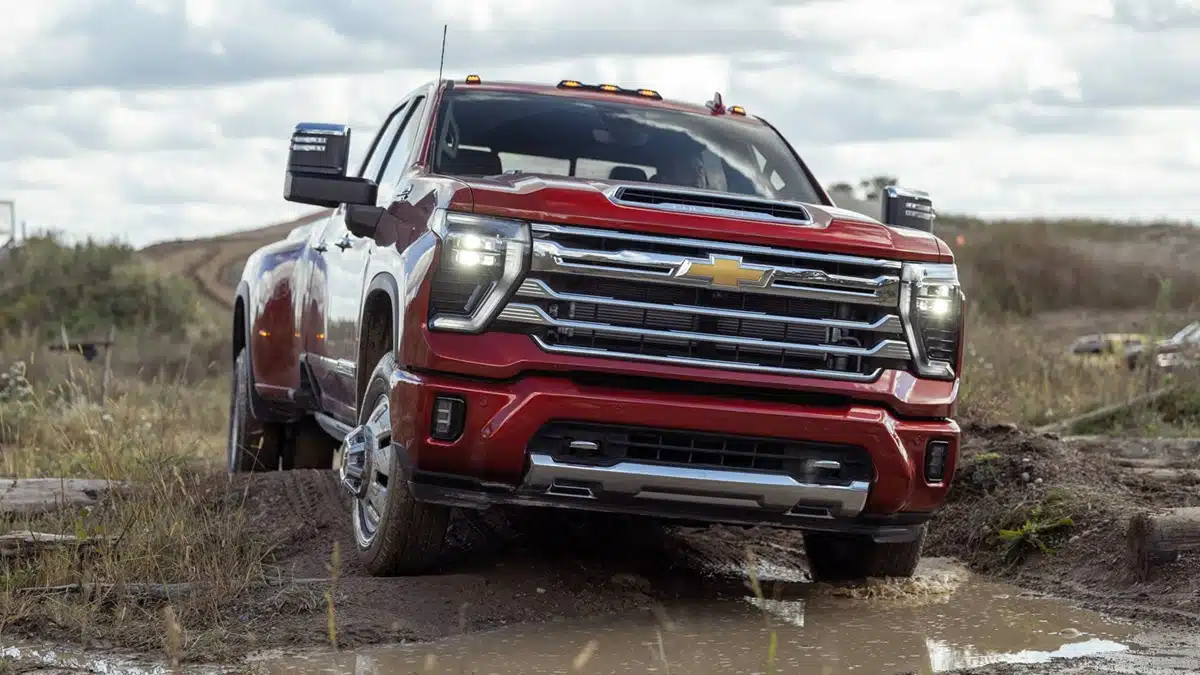
2025 HD Gas vs Diesel Towing Capacity Chart
The 2025 heavy-duty gas vs diesel decision is not just about the pump price any more.
It is about how far you tow, how heavy you run, and how much payload and stability you need from the same truck.
This chart-driven guide compares gas and diesel towing in the 2025 Ford Super Duty, Ram HD, Chevrolet Silverado HD, and GMC Sierra HD lineups so you can spec the right engine for real trailers, not brochure fantasy.
Why Gas vs Diesel Still Matters in 2025 🚛
Gas HD engines deliver strong peak horsepower, lower upfront cost, and excellent payload numbers for contractors and mixed-use owners.
Diesel HD engines bring massive torque, higher GCWR, and better control on grades, which matters when you are living near the top of the tow chart week after week.
The key is that each brand’s gas and diesel pairings are tuned for different use cases, and the towing charts make that tradeoff very clear.
2025 HD Gas vs Diesel Towing Snapshot 🚚
This snapshot table compares representative 2025 gas and diesel towing ratings from Ford, Ram, Chevrolet, and GMC so you can see how engine choice changes the numbers when trucks are properly equipped.
| Truck and series (2025)Gas HD engine max towing (approx, properly equipped)Diesel HD engine max towing (approx, properly equipped)Notes | |||
|---|---|---|---|
| Ford F-250 Super Duty | Up to about 18,200 lb conventional and 19,500 lb fifth-wheel with 7.3L gas V8 | Up to about 22,000 lb conventional and 23,000 lb fifth-wheel with 6.7L diesels | Ford’s towing guide shows gas near the top for payload but diesel leading on max trailer weights. |
| Ford F-350 Super Duty | Up to about 22,000 lb conventional and 22,500 lb fifth-wheel with 7.3L gas V8 in certain DRW builds | Up to about 28,000 lb conventional and 38,000 lb fifth-wheel with high-output 6.7L diesel | F-350 is the clearest gas vs diesel spread in the Super Duty range. |
| Ram 2500 HD | Up to about 17,750 lb max towing with 6.4L HEMI V8 | Up to about 20,000 lb max towing with 6.7L Cummins High-Output diesel | Official capability pages highlight gas payload vs diesel towing tradeoff. |
| Chevrolet Silverado 2500 HD | Roughly mid-17,000 to high-18,000 lb max towing with 6.6L gas V8 depending on cab and drive | Up to about 22,420 lb fifth-wheel or gooseneck towing with 6.6L Duramax diesel and Max Trailering | Dealer and factory charts show gas strong but diesel clearly ahead on peak numbers. |
| GMC Sierra 2500 HD | Gas V8 typically in mid-17,000-lb towing range when properly equipped | Up to about 20,000 lb conventional and 22,500 lb fifth-wheel or gooseneck with Duramax diesel | GMC comparison pages position diesel as the tow choice and gas as the payload and value play. |
These are peak ratings for specific builds, so your own truck will usually tow less once you add options, passengers, and real gear.
Ford Super Duty: Gas V8s vs Power Stroke Diesels 🛻
Ford offers the 2025 Super Duty with 6.8L and 7.3L gas V8s plus standard and high-output 6.7L Power Stroke diesels, and the towing guide shows a clear split between gas payload and diesel trailer weight.
On the F-250 side the 7.3L gas V8 tops out around 18,200 pounds conventional and 19,500 pounds fifth-wheel while the high-output 6.7L diesel reaches about 22,000 pounds conventional and 23,000 pounds fifth-wheel in its best combinations.
On the F-350 side the gap gets wider, because dual-rear-wheel diesel trucks stretch up into the 38,000-pound fifth-wheel range while the biggest gas numbers live in the low-20,000s.
If you spend more time loaded on the bed than on the hitch, the big 7.3L gas V8 keeps cost down and payload up.
If you are actually using the fifth-wheel numbers on the brochure, the Power Stroke diesels are the proper starting point for your build sheet.
Ram HD: HEMI Gas vs Cummins Diesel Torque 🛻
Ram’s 2025 HD story is split between the 6.4L HEMI V8 for gas buyers and the 6.7L Cummins inline-six for diesel shoppers, with both standard and High-Output diesel variants in the catalog.
Ram 2500 capability pages show the 6.4L HEMI towing up to about 17,750 pounds while the Cummins diesel stretches to roughly 20,000 pounds when properly equipped, and they also highlight the higher gas payload figures contractors appreciate.
Ram 3500 diesel charts go even further, with High-Output Cummins dually trucks matching the huge fifth-wheel numbers you see from Ford and GM and placing Ram squarely in the one-ton capacity race.
If you tow heavy but not at the ragged edge and you want lower buy-in, the 6.4L gas HEMI still makes sense for many Ram HD owners.
If you are spec-ing a hotshot truck or large fifth-wheel hauler, the diesel Cummins is the only rational direction.
Silverado and Sierra HD: Gas 6.6 vs Duramax 6.6 🛻
Chevrolet and GMC both run the same 6.6L gas V8 and 6.6L Duramax diesel across their 2500 HD and 3500 HD lineups, but their own research pages are blunt about which engine to choose if towing is your priority.
Dealer and factory trailering charts show many 2025 Silverado 2500 HD gas builds topping out in the high-17,000- or mid-18,000-pound range while Duramax diesel versions with Max Trailering and fifth-wheel or gooseneck prep hit up to about 22,420 pounds.
On the GMC side the Sierra 2500 HD gas V8 usually trails just behind those figures while Duramax diesels reach roughly 20,000 pounds conventional and 22,500 pounds fifth-wheel or gooseneck when they are configured as tow specialists.
If your main job is hauling tools, materials, and lighter bumper-pull trailers, the 6.6L gas V8 offers honest power and less upfront cost.
If you are dialing in a trailer-first 2500 or 3500 build, the Duramax diesel is the correct column to live in on the order form.
Gas vs Diesel: How the Drive Feels 🚗
Gas HD engines generally rev higher and shift more often as they climb grades, which can feel busy with a large trailer even when the numbers say the combination is legal.
Diesel HD engines make big torque down low in the rev range and add exhaust braking on long descents, which gives them a calmer and more controlled feel at the same loaded weight.
Gas trucks often feel more responsive when unloaded and around town, with less upfront weight over the front axle and quicker pedal response at light throttle.
Diesel trucks usually feel heavier and more planted even without a trailer, but they really come into their own when you cross into five-digit trailer weights and long highway grades.
Where Gas HD Trucks Still Win 🛻
Gas HD engines usually bring lower purchase price, lower fuel equipment complexity, and easier ownership for drivers who tow less frequently.
Payload ratings often favor gas engines because they weigh less than diesels, which matters if you are hauling slide-in campers, tool bodies, or heavy bed loads more than big trailers.
Short-trip driving and cold climates tend to treat gas engines more kindly, especially when trucks spend long periods idling on job sites or making multiple short hops per day.
If you tow in the 8,000- to 12,000-pound window only a few times a month, a gas HD often delivers 90 percent of what you need in a simpler package.
Where Diesel HD Trucks Earn Their Keep 🛻
Diesel HD engines shine once you live in the 12,000- to 20,000-plus-pound trailer zone or tow in mountains and high winds on a regular basis.
Higher GCWR, integrated exhaust brakes, and tall fifth-wheel and gooseneck ratings all work together to keep speed and temperature under control in heavy conditions.
Fuel economy under load is typically better for diesels, so long-distance haulers often see meaningful savings over thousands of miles even when diesel costs a bit more per gallon.
If you plan to keep the truck for many years and pile on serious miles while towing heavy, the diesel premium tends to pay back over time in control, comfort, and resale value.
Payload, Tongue Weight, and Safety Basics 🛻
No matter which engine you pick, the real limits are gross vehicle weight rating, gross axle weight ratings, and gross combined weight rating printed on the stickers and in the manual.
Conventional tongue weight typically runs about 10–15 percent of loaded trailer weight, while fifth-wheel and gooseneck pin weight often sits around 15–25 percent, and all of that counts against payload and axle ratings.
A 14,000-pound trailer can easily place 1,400–3,000 pounds on the truck depending on hitch type and loading, which will expose any payload weakness in high-content trims and off-road packages.
Using TruckReportGeeks as Your Research Hub 🛻
If you are choosing between a gas Ram 2500 and a diesel Ram 2500 or trying to decide whether a Ford F-250 Power Stroke is really worth the jump from the 7.3L gas, the deep-dive towing breakdowns at TruckReportGeeks help you turn charts into practical decisions.
Those articles also show where a gas 2500 or 3500 is perfectly adequate and where moving to a diesel or even stepping up into a higher-class truck is the smarter long-term play.
2025 HD Gas vs Diesel: Quick Scenario Guide 🚚
Pick a gas HD if you tow under about 10,000–12,000 pounds most of the time, care more about payload than trailer weight, and want simpler emissions hardware in day-to-day use.
Pick a diesel HD if your loaded trailer weight frequently runs over 12,000–14,000 pounds, you see mountains and crosswinds often, or you plan to rack up a lot of towing miles every year.
Use internal comparison tools at TruckReportGeeks to line up gas and diesel charts side by side, and then overlay your own trailer weights and driving routes instead of starting from national marketing claims.
Setup Checklist Before You Decide 🛻
🛞 Weigh your current or planned trailer fully loaded and record real tongue or pin weight instead of using brochure dry numbers.
🚛 Compare that real weight against gas and diesel towing charts for the specific trucks you are considering, not generic “up to” figures.
🛻 Check payload and axle ratings for high-content trims because features, leather, and large wheels eat into the payload you need for safe tongue or pin weight.
⚙️ Consider your annual towing mileage and terrain so you can weigh diesel’s extra control and efficiency against gas’s lower purchase and maintenance complexity.
What is the biggest towing advantage of a diesel HD truck over a gas HD truck
A diesel HD truck usually offers higher GCWR, stronger fifth-wheel and gooseneck ratings, and better control on long grades thanks to low-rpm torque and exhaust braking.
When does a gas HD truck make more sense than a diesel
A gas HD truck makes more sense if you tow under about 10,000–12,000 pounds most of the time, drive short trips, care more about payload, and want a lower up-front purchase price.
Do gas HD trucks really have higher payload than diesel versions
Yes, gas engines usually weigh less than diesels, so the same chassis with a gas engine often has a higher payload rating that can be critical for slide-in campers and heavy bed cargo.
How much trailer weight justifies paying extra for a diesel
Once your loaded trailer weight regularly lives above roughly 12,000–14,000 pounds or you tow in mountains and crosswinds, the diesel’s extra torque, GCWR, and braking control usually justify the cost.
Does a diesel HD always get better fuel economy than gas when towing
In most real towing situations a diesel HD truck uses less fuel per mile than an equivalent gas truck, especially at higher trailer weights and highway speeds.
Are diesel HD trucks more expensive to maintain than gas HD trucks
Yes, diesel HD trucks often have higher parts and fluid costs and more complex emissions systems, but their longer service life under heavy load can offset some of that for high-mileage owners.
Can I exceed my truck’s payload if I stay under the tow rating
Yes, you can exceed payload or rear-axle rating even when your trailer weight is under the published tow rating, which is why you must check payload, GAWR, and GCWR and not just the big tow number.
Should I upgrade from gas to diesel if I am already near my limits
If your current gas HD truck runs close to GVWR, GAWR, or GCWR with your trailer, moving to a diesel HD with higher combined ratings—or even the next class up in truck size—is usually the safer long-term choice.
Final Thoughts 🚗
The 2025 HD gas vs diesel towing decision is less about fan loyalty and more about matching the right engine and package to the way you actually tow.
If you measure real weights, respect payload and axle ratings, and use charts and guides like this alongside the detailed breakdowns at TruckReportGeeks, you will end up with a truck that feels relaxed instead of maxed-out every time you drop the trailer on the hitch.
Sources