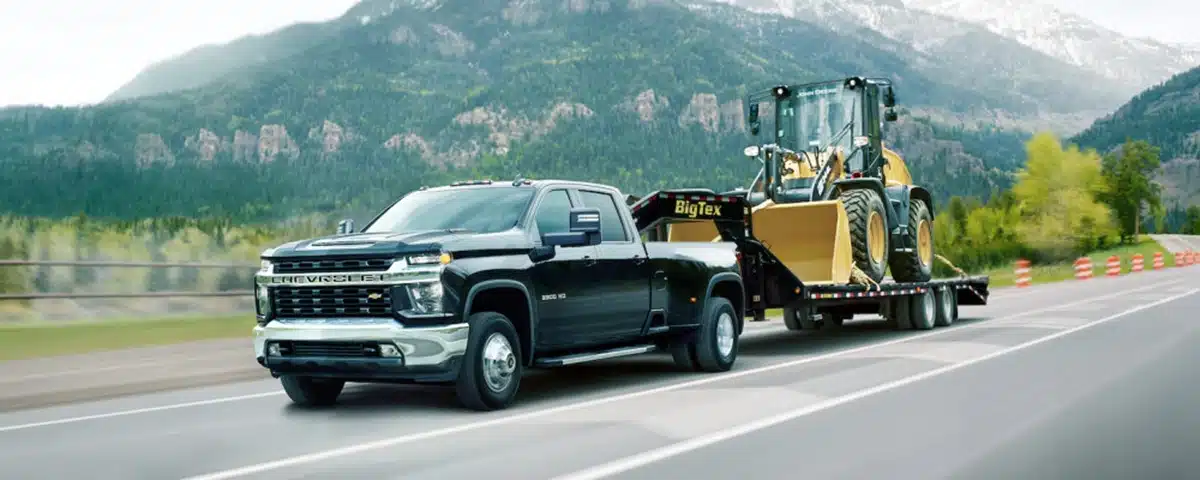
Silverado 1500 Towing Limits
Your Silverado 1500 can be tow-rated for big numbers, but you still must stay under:
- Hitch receiver limits (weight-carrying vs weight-distributing)
- Max trailer tongue load (the truck’s allowed downward load at the hitch)
- Rear GAWR (RGAWR) and GVWR (the truck’s axle and total weight limits)
Chevrolet specifically warns that added tongue weight must not push the truck past RGAWR, GVWR, or Max Trailer Tongue Load.
🔎 The “real limit” hierarchy (what actually stops you first)
Most owners think towing is one number.
In real life, your safe towing limit is the lowest limit you hit first.
Quick comparison table (what each limit means + where to find it)
| Limit | What it controls | Where you find it | Why it matters |
|---|---|---|---|
| Hitch rating (WC vs WD) | Max trailer weight + max tongue weight the receiver/ball mount can take | Hitch label / receiver sticker and Owner’s Manual | You can be “under tow rating” but over hitch tongue rating. |
| Max Trailer Tongue Load | The truck’s allowed downward load from the trailer | Trailering/owner info + vehicle labels | Chevy explicitly says tongue weight must not exceed this. |
| Rear GAWR (RGAWR) | Max weight allowed on the rear axle system | Driver door jamb certification label | Tongue weight loads the rear axle fast. GAWR is manufacturer-defined axle-system capacity. |
| GVWR | Max loaded weight of the whole truck | Driver door jamb certification label | GVWR is manufacturer-defined max loaded vehicle weight. |
| GCWR | Max combined weight of truck + trailer | Trailering Guide | You can be under GVWR but still exceed GCWR depending on trailer. |
🧮 Tongue weight math (the fastest way to see if you’re doomed)
Chevrolet’s 2025 guide states:
- Conventional tongue weight should be 10%–15% of total loaded trailer weight.
- The added tongue weight must not cause the vehicle to exceed RGAWR, GVWR, or Max Trailer Tongue Load.
Two quick examples
Example A: 7,000 lb loaded trailer
Tongue weight target = 700–1,050 lbs (10%–15%).
That tongue weight is payload.
It “spends” your rear axle capacity and GVWR immediately.
Example B: 9,000 lb loaded trailer
Tongue weight target = 900–1,350 lbs.
This is where many half-ton builds become payload/RGAWR-limited even if the tow rating looks fine.
🧷 Hitch limits (weight-carrying vs weight-distributing)
This is the part that quietly wrecks towing setups.
Many hitches have two ratings:
- WC (Weight-Carrying): trailer rests on the ball, tongue weight is carried mostly by the rear of the truck
- WD (Weight-Distributing): spring bars leverage load to help distribute weight forward, improving level and stability
SAE J684 defines these hitch types and distinguishes weight-carrying vs weight-distributing devices.
Practical rule: Use the rating that matches your setup.
If you tow “as WC” but you are reading “WD numbers,” you can be overloaded without realizing it.
🏷️ GAWR and GVWR (the two labels that matter more than the brochure)
NHTSA’s definitions are clean:
- GAWR = manufacturer-specified load capacity of a single axle system measured at tire-ground interfaces.
- GVWR = manufacturer-specified loaded weight of a single vehicle.
Why towing breaks these limits first: Tongue weight loads the rear axle, and passengers/bed cargo stack on top of it.
That is why Chevrolet explicitly ties tongue weight compliance to RGAWR and GVWR.
✅ The “safe towing” process (what to do in order)
1) Identify your Silverado’s tow row (engine/cab/bed/2WD/4×4/package)
Use the 2025 towing tables for your exact configuration.
Example: the 2025 guide shows Silverado 1500 conventional towing values up to 13,300 lbs on specific configurations, but the guide also warns that passengers/cargo/options reduce what you can trailer.
2) Read your hitch receiver ratings (WC and WD)
Do not guess.
Use the hitch label and your ball mount ratings.
Your “max tow” number does not override hitch limits.
3) Calculate target tongue weight (10%–15%)
Then confirm that tongue weight does not push you over RGAWR/GVWR/Max Trailer Tongue Load.
4) Weigh it (best practice)
If you tow often, weigh the truck/trailer.
This is the only way to confirm axle weights vs GAWR and total weight vs GVWR.
- 2025 Chevrolet Trailering Guide
- NHTSA definition of GAWR and GVWR NHTSA
- NHTSA towing safety overview (weights and hitch system considerations) NY Military Affairs
❓ FAQs
What is the single most common towing limit on a Silverado 1500?
Payload / rear axle (RGAWR) limits, because tongue weight plus passengers and cargo stack quickly.
If my truck can tow 11,000–13,300 lbs, does that mean my tongue weight can be 1,300+ lbs?
Not automatically.
Tongue weight should be 10%–15%, but Chevrolet also requires you stay under RGAWR, GVWR, and Max Trailer Tongue Load, and your hitch has its own tongue rating
Where do I find my exact GAWR and GVWR?
On your driver door jamb certification label.
GAWR and GVWR are manufacturer-defined values.
🏁 Conclusion
For a Silverado 1500, “tow rating” is only the beginning.
Your real towing ceiling is the lowest limit you hit first: hitch rating, max tongue load, rear GAWR, or GVWR—and Chevrolet explicitly ties tongue weight to those limits.
Like and comment with your Silverado 1500 trim, cab/bed, drivetrain, and your trailer’s loaded weight.
I’ll estimate your tongue-weight range and tell you which limit (hitch, tongue, RGAWR, or GVWR) you’re most likely to hit first and come back again Truck Report Geeks