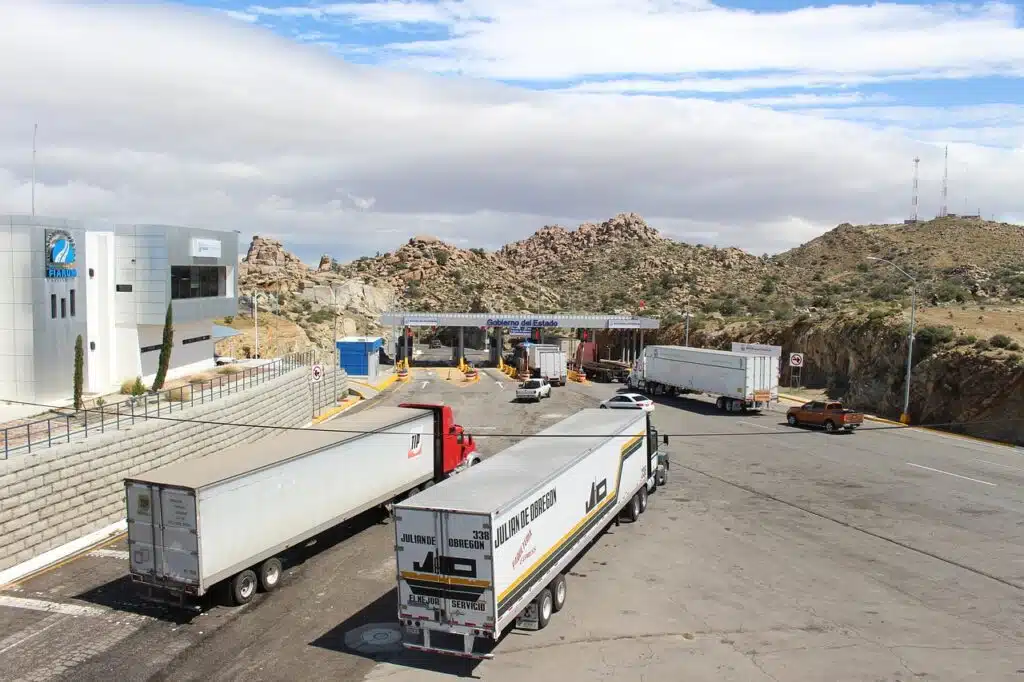
53 Foot Trailer Dimensions & Weight
A typical 53’ dry van trailer weighs about 13,500–15,000 lbs empty (tare), depending on build and options.
A typical tractor often weighs 17,000–20,000 lbs, depending on sleeper/day cab and equipment.
So if you’re running a standard U.S. legal maximum of 80,000 lbs gross, a realistic payload is usually mid-40,000 lbs, and sometimes less once you account for axle limits, fuel, and gear.
📊 53-Foot Trailer Dimensions & Weight by Trailer Type
| Trailer Type | Exterior Length | Exterior Width | Exterior Height | Interior Height | Door Opening Height | Empty Weight (lbs) | Max Payload (lbs) |
|---|---|---|---|---|---|---|---|
| Dry Van | 53 ft (636 in) | 102 in (8.5 ft) | 162 in (13.5 ft) | 110 in (9.1 ft) | 108 in (9 ft) | ~14,000 | ~45,000 |
| Reefer (Insulated) | 53 ft | 102 in | 162 in | 100–104 in (due to insulation) | ~100 in | ~15,500 | ~44,000 |
| Flatbed | 53 ft | 102 in | — (open deck) | N/A | N/A | ~10,000 | ~48,000 |
| Double Drop | 53 ft | 102 in | Deck: ~18 in | N/A | N/A | ~12,000 | ~46,000 |
53-Foot Trailer Legal Weight Calculator
Select a jurisdiction, review baseline limits, and (optionally) estimate legal payload. Advanced tab includes the Bridge Formula. Info tool — verify with official DOT/Ministry
Baseline legal limits
Quick payload estimator (optional)
Advanced: Federal Bridge Formula (U.S. only)
Bridge Formula: W = 500[(L·N/(N−1)) + 12N + 36] (rounded to nearest 500 lb). Applies on U.S. Interstates/National Network;
actual legal weight is the lowest limit among GVWR, axle-group limits, and Bridge result.
About
Baselines use U.S. Interstate standards (80,000 lb GVWR; 20,000 lb single axle; 34,000 lb tandem) and widely-cited KPRA notes where available (e.g., CA 40’, CT 43’, FL 41’, IL 45’6”, IN 43’, MD 41’, MN 43’, NH 41’, NJ 41’, NY 43’, RI 41’).
For Canada and non-Interstate roads, limits vary — verify with official state/provincial transport authorities.
📏 Exterior Dimensions: What “53-Foot Trailer” Really Means
Exterior length: 53 feet (636 inches) is the standard dry-van / reefer / flatbed length for most U.S. linehaul freight.
Exterior width: Most are 102 inches (8’6”), which is the widely used legal standard for highways and freight equipment.
Exterior height: Most van trailers are designed around 13’6” overall height, because that aligns with common clearance expectations in the U.S. freight network.
📦 Interior Dimensions (Dry Van): Real Specs You Can Use
This is the part many “dimension” pages skip, but it is what searchers actually need.
A widely published benchmark for a modern 53’ dry van is:
Interior height: about 110.5” at the front and ~111” at the rear (typical).
Interior width: commonly ~100” at the wearband (some configs list 101”).
Interior length (usable): usually around 52’+ usable cargo space, depending on ICC bumper, interior lining, and spec.
If you want manufacturer-grade numbers you can cite, Utility Trailer publishes interior height and width values in their dry van specs.
Wabash Canada also publishes 53’ dry van dimensions including interior height and width.
🚪 Door Opening Size (The “Will My Freight Fit?” Question)
For many shippers, the door opening height matters more than the roof height.
A common published example:
Door opening height: about 110.5” on some dry-van configurations (increases forklift clearance).
Reefers often have slightly tighter interior and door dimensions because of insulation and equipment packaging, so the “same exterior” does not mean “same usable opening.”
⚖️ Weight: What a 53’ Trailer Actually Weighs Empty
This is where your current article needed the biggest correction.
A 53’ dry van is not ~35,000 lbs empty.
A more credible dry-van tare range is typically 13,500–15,000 lbs, depending on build and options (liners, logistics posts, tires, etc.).
A reefer will usually weigh more because of insulation and refrigeration equipment.
A flatbed can be lighter (especially aluminum designs).
Practical takeaway:
If your tractor is ~19,000 lbs and your dry van is ~14,000 lbs, your “simple math” payload under 80,000 is:
80,000 – 19,000 – 14,000 = 47,000 lbs.
But real-world legal payload often settles around 44,000–45,000 lbs because axle group limits and bridge constraints can become the binding factor before you hit the gross cap.
🧮 Legal Limits That Control 53’ Trailer Payload (U.S.)
Most readers care about two things:
1) The gross cap.
2) The axle caps that get you fined first.
At a federal level on the U.S. Interstate system, the commonly cited limits are:
80,000 lbs gross vehicle weight (GVW).
20,000 lbs single axle.
34,000 lbs tandem axle group.
Federal Bridge Formula (Why axle spacing matters)
Even if you are under 80,000 lbs gross, you can still be illegal if weight is concentrated wrong.
That is where the Federal Bridge Formula comes in.
📌 KPRA: Why Some 53’ Trailers Are “Legal” and Some Routes Aren’t
KPRA means kingpin to rearmost axle (or kingpin to rear axle group center, depending on how a state measures).
This matters because a trailer can be 53’ long but still fall outside a state’s “permit-free” criteria if KPRA is too long.
FHWA guidance explains that 53’ semitrailers may operate without a permit if they conform to specific kingpin-to-rearmost axle distances (commonly cited around 40’6”, with additional notes for certain cases).
Practical takeaway:
If you run multi-state, do not treat “53’” as automatically permit-free everywhere.
Treat KPRA as a routing constraint and verify your lane network.
🧱 How Many Pallets Fit in a 53’ Trailer?
Here’s the clean, usable answer most people came for.
With standard GMA pallets (48” x 40”), a 53’ dry van commonly fits:
26 pallets with straight loading.
28 pallets with pinwheel loading (common optimization pattern).
Up to 30 pallets with “turned/sideways” loading in certain scenarios (depends on true interior width and how much clearance you need).
Important:
Pallet count is only half of the story.
Your true limiting factor might be weight, not space, especially with dense commodities.
🧰 Cargo Securement (Yes, It Applies to Enclosed Trailers)
Even inside a dry van, you’re still responsible for securement standards.
FMCSA’s cargo securement rules require that cargo securement systems and devices meet performance requirements, and they apply broadly to CMVs transporting cargo.
If you want a practical tool before you roll, a portable axle scale can help validate weights before you get surprised at the first certified scale. (Affiliate link stays below.)
🚛 What Can You Haul in a 53-Foot Trailer?
Dry Van
Consumer goods, boxed freight, palletized retail, packaged industrial components.
Reefer
Perishables, dairy, produce, frozen freight, pharmaceuticals (temperature-controlled).
Flatbed
Steel, lumber, equipment, building materials, oversized crated freight (securement-critical).
If you need help matching trailer type to cargo, browse the Semi Truck Report section on TruckReportGeeks for more equipment guidance.
🔗 Tools You’ll Actually Use
If you want to turn this article into a conversion point (and improve engagement), direct readers to your tools hub:
Truck Calculators (TruckReportGeeks)
| Specification | Measurement | Notes |
|---|---|---|
| Internal Length | 53 feet | Usable cargo space |
| External Length | Approximately 55 feet | Includes overhangs |
| Width | 8 feet 6 inches (standard) | Some wider models exist |
| Internal Height | 109.1 inches (typical) | |
| Maximum External Height | 13.5 feet | Legal limit for the entire rig |
| Maximum Loaded Weight | 80,000 lbs (most areas) | Includes trailer and cargo |
| Typical Empty Weight (Dry Van) | 35,000 lbs | Can vary based on materials |
| Maximum Cargo Weight | 45,000 lbs | Assumes typical empty weight |
What are the standard dimensions of a 53-foot semi trailer?
A standard 53-foot semi trailer is typically 53 feet long, 8.5 feet wide (102 inches), and around 13.5 feet tall when combined with the tractor. The interior height may vary, but most dry vans and reefers provide about 110 to 114 inches of usable vertical space.
How much weight can a 53-foot trailer legally carry?
In the U.S., the legal gross weight limit for a 53-foot semi trailer is 80,000 pounds including the truck and trailer. The typical cargo capacity is around 43,000 to 45,000 pounds depending on the trailer type and configuration.
How many pallets fit in a 53-foot trailer?
26–30 standard pallets (48” x 40”), depending on straight or pinwheeled loading.
Can a 53-foot trailer operate in all states?
Yes, but some states require permits for specific routes or higher weights.
The Takeaway
The Takeaway
A 53-foot trailer is the North American workhorse because it balances cube, payload potential, and routing flexibility.
If you remember only two things:
Interior and door dimensions drive “will it fit.”
Axles and bridge rules drive “is it legal.”
We hope you enjoyed this post on 53 Foot Trailer Dimensions & Weight—please share your comments below.
Sources:
- Onsite Truck AZ: How Much Does a Semi Truck Weigh? Ultimate Guide (2022): https://www.onsitetruckaz.com/post/how-much-does-a-semi-truck-weigh-ultimate-guide-2022
- Stream Logistics: Trailer Dimensions: https://streamlogistics.com/trailer-dimensions/
- Schneider Jobs [How Long is a Semi Truck? And other 18-Wheeler Dimension Facts] (https://schneiderjobs.com/blog/how-long-is-semi-truck)
- Paige Logistics [Ultimate Guide to Truckload Trailer Types for Freight] (https://www.paigelogistics.com/truckload-trailer-types/)
If you desire to increase your familiarity simply keep visiting this
web page and be updated with the hottest information posted here.