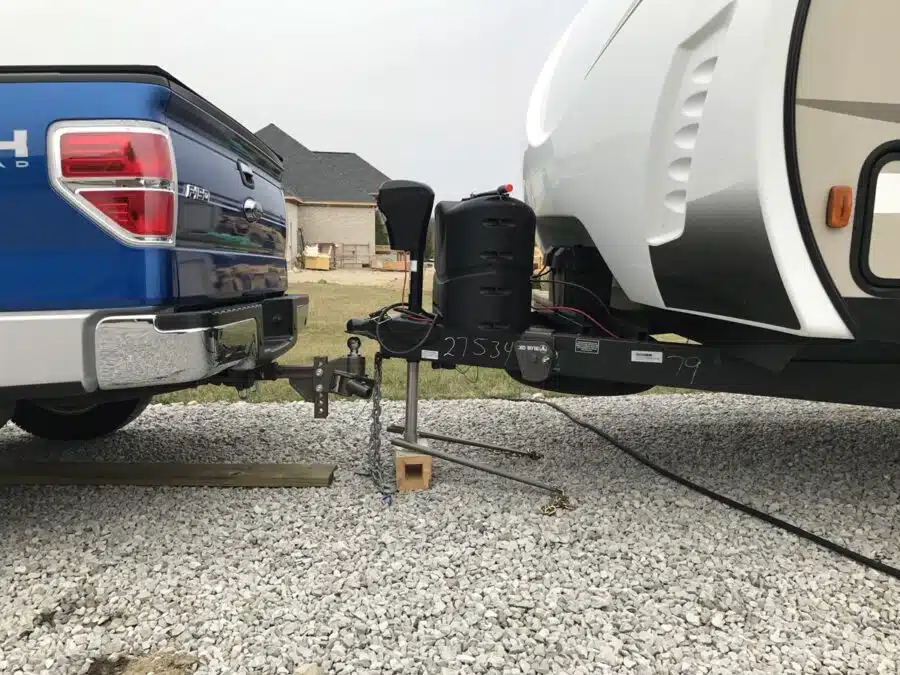
F-150 Weight Distribution Hitch
If your loaded trailer is over 5,000 lbs, Ford’s towing guide notes you should not tow without a weight-distribution system.
A WDH is designed to distribute tongue weight among the tow vehicle and trailer axles, improving control and stability.
📊 Quick table: when you need a WDH
| Loaded trailer weight | WDH recommended? | Why it matters |
|---|---|---|
| 0–5,000 lbs | Often optional | Still helpful if the rear sags, steering feels light, or sway shows up. |
| Over 5,000 lbs | Yes (per Ford guidance) | Ford’s towing guide includes a 5,000-lb “do not exceed without WDH” note. |
| 7,000–12,000+ lbs | Yes + sway control strongly recommended | More tongue weight transfer, more stability demands, more braking/handling sensitivity. |
🔧 What a weight-distribution hitch actually does
A WDH uses spring bars and geometry to spread tongue weight across:
- the F-150’s front axle,
- the F-150’s rear axle,
- and the trailer axles.
That matters because too much rear squat can reduce steering authority and can change braking/handling behavior.
✅ The simplest “do I need it?” checklist
Use a WDH if any of the following are true:
- Your loaded trailer is over 5,000 lbs (Ford’s guidance).
- The rear of the truck squats noticeably after you hitch up.
- The steering feels lighter than normal.
- You feel sway or “push” when passed by trucks or in crosswinds.
- Your trailer is a travel trailer with higher side area (more wind leverage).
⚠ The two numbers people confuse (and why a WDH helps)
Trailer weight is not the same as tongue weight.
Tongue weight is the downward force on the hitch.
Ford’s towing notes commonly reference tongue load assumptions and staying within vehicle ratings (GVWR/GAWR/GCWR).
A WDH does not “increase” your truck’s official tow rating.
It helps you tow within those limits with better control by managing how the load is shared.
🧰 How to choose the right WDH for an F-150
1) Match the WDH to your loaded tongue weight
Do not size the hitch to an empty trailer brochure number.
Size it to how you tow it on the road.
If you’re unsure, weigh the tongue or estimate conservatively.
2) Choose sway control when towing travel trailers
Sway control is not a luxury feature for large, tall trailers.
It is a stability tool.
3) Ensure your receiver and hitch components are rated correctly
Your receiver, ball mount, ball, pins, and chains must match the load.
NHTSA’s towing safety guidance emphasizes being properly equipped and using manufacturer recommendations for hitch selection.
✅ Setup basics (high-level, practical)
A properly set WDH typically aims to:
- reduce excessive rear sag,
- restore a more level stance,
- improve steering feel,
- and stabilize the combination.
If you install it and the truck still sits tail-low, or the trailer runs nose-up, your setup likely needs adjustment.
🚫 Common mistakes that cause bad towing even with a WDH
- Sizing the WDH too light for real tongue weight.
- Not torquing hardware correctly (creates slop, noise, and instability).
- Ignoring trailer loading (a WDH cannot “fix” a poorly loaded trailer).
- Assuming airbags replace a WDH.
Airbags can level ride height, but they do not distribute load the same way a WDH does.
- Ford towing calculator (VIN-based towing capacity lookup) Ford Motor Company
- Ford towing hub (guides + calculator access) Ford Motor Company
- NHTSA towing safety PDF: being equipped for safety NY DMNA
❓ FAQs
Do I need a weight-distribution hitch on an F-150?
If your loaded trailer is over 5,000 lbs, Ford’s towing guide notes you should not exceed that weight without a weight-distribution system.
What does a weight-distribution hitch do?
It uses special components to distribute tongue weight among the tow vehicle and trailer axles, improving stability and control.
Does a WDH increase towing capacity?
A WDH helps you tow more safely and level under load.
It does not replace the need to stay within your vehicle ratings (GVWR/GAWR/GCWR) and the manufacturer’s towing guidance.
Should I also use sway control?
For many travel trailers, sway control is a practical stability upgrade, especially in wind or when being passed.
NHTSA’s towing safety guidance discusses the importance of being properly equipped for safe trailering.
🏁 Conclusion
If you want the cleanest rule:
Over 5,000 lbs loaded trailer weight = run a WDH, consistent with Ford’s towing guide note. Ford VDM
Then size it to your real tongue weight.
And pair it with proper loading and rated components for a stable, predictable tow.
Like and comment with your trailer loaded weight, tongue weight estimate, and your F-150’s cab/bed/engine, and I’ll tell you what WDH rating range you should be shopping and visit us again truckreportgeeks.com