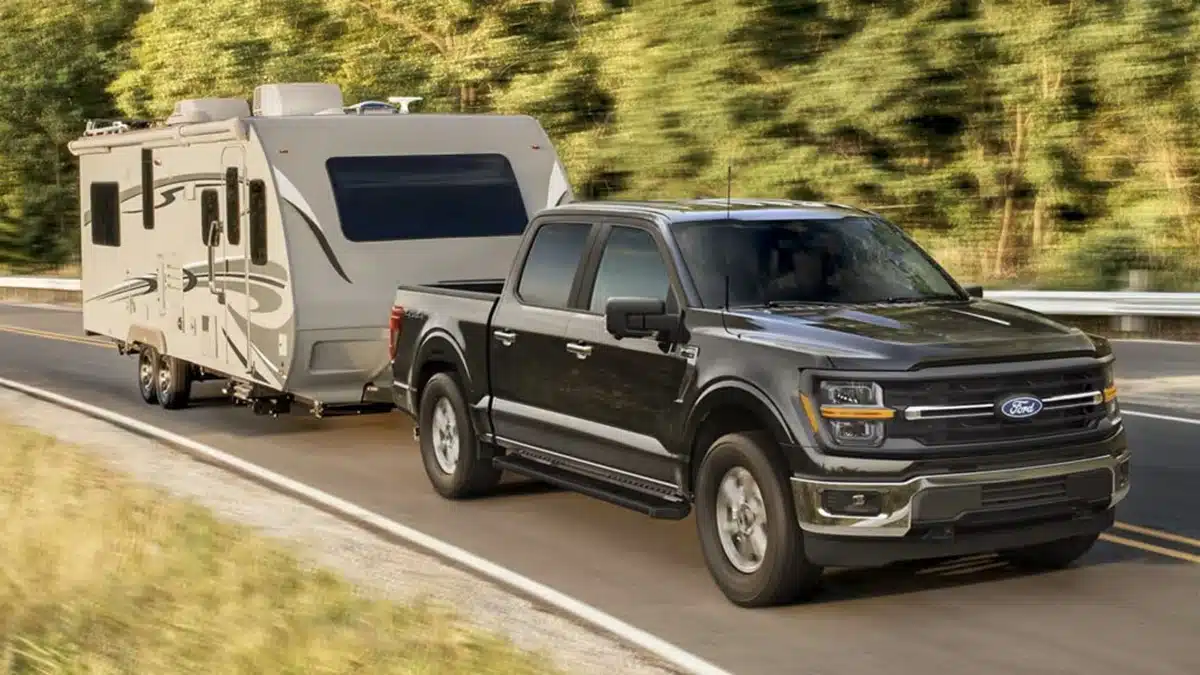
Can My F-150 Tow My Trailer
Yes—most F-150s can tow most common trailers.
But the “real” limit is usually payload + tongue/king pin weight, not the marketing tow number.
If your trailer is over 5,000 lbs, Ford notes a weight-distributing hitch is required (and Ford also ties this to tongue weight thresholds).
📊 Comparison table (the 3 most common outcomes)
| What you’re trying to do | What usually stops you first | Fast fix |
|---|---|---|
| Tow a travel trailer | Payload disappears from tongue weight + people + gear | Reduce trailer weight, reduce truck cargo, or increase truck payload margin |
| Tow “within rating” but it feels unstable | Wrong hitch setup and/or poor loading | Use a WDH (and sway control when appropriate) and re-load trailer correctly |
| Buy a trailer based on brochure numbers | “Dry weight” is not what you tow | Use loaded trailer weight and measured/estimated tongue weight |
✅ Quick checklist (5 minutes, no guessing)
Step 1: Get the two numbers that matter
A) Your truck’s payload (from the door sticker).
Payload is your “budget” for passengers, cargo, hitch hardware, and tongue/king pin weight.
B) Your trailer’s loaded weight (not dry weight).
If you don’t have a scale ticket, estimate conservatively (water, propane, batteries, food, gear).
Step 2: Estimate tongue weight (or king pin weight)
For conventional bumper-pull trailers, Ford towing guidance commonly uses tongue load assumptions and requires staying under axle and vehicle ratings.
A practical planning rule is ~10–15% for most bumper-pull trailers (varies by trailer type and loading). dmna.ny.gov
For 5th-wheel/gooseneck setups, Ford’s towing guidance uses higher king pin load assumptions than conventional tongue weight.
Step 3: Subtract payload like a budget
Add these together:
- Tongue/king pin weight
- Passengers
- Bed cargo
- Aftermarket accessories (toolboxes, tonneau, etc.)
- Hitch hardware (ball mount, WDH head/spring bars if used)
If the total is near or over your door-sticker payload, your trailer may be “towable” on paper, but it is not a good match in real life.
Step 4: Confirm the WDH threshold (this is where people fail)
Ford’s owner guidance states:
A weight-distributing hitch is required to tow over 5,000 lb maximum trailer weight or 500 lb tongue weight (vehicle-dependent note).
If your trailer is above those thresholds, you should plan for:
- A properly rated weight-distributing hitch
- Correct setup (leveling and spring bar tension)
- Sway control where appropriate (especially travel trailers)
Step 5: Verify you are under GVWR, rear GAWR, and GCWR
Ford’s towing guidance emphasizes that towing limits depend on configuration and that added tongue load plus passengers/cargo must not exceed axle/vehicle ratings, and the combined vehicle + trailer must stay within GCWR.
If you want the fastest, least-error method: run your VIN through Ford’s towing calculator to get truck-specific limits for maximum loaded trailer weight and maximum tongue weight.
🧾 Two “sanity check” examples
Example A: You’re probably good
Loaded trailer: 5,800 lbs
Estimated tongue weight (12%): 696 lbs
Passengers + gear + hitch hardware: 650 lbs
Total payload used: 1,346 lbs
If your door-sticker payload is around 1,700–2,000 lbs, you likely have workable margin (still confirm rear axle and combined weight).
Example B: You’re likely overloaded (even if the tow rating looks fine)
Loaded trailer: 8,500 lbs
Estimated tongue weight (13%): 1,105 lbs
Passengers + gear + hitch hardware: 750 lbs
Total payload used: 1,855 lbs
If your door-sticker payload is 1,600–1,900 lbs, you are essentially out of payload before you add anything else.
- Ford towing calculator (VIN-based tow rating + tongue weight) https://www.ford.com/
- How to use the Ford towing calculator (official guide) https://www.ford.com/
- NHTSA towing safety PDF (hitch types, stability basics) dmna.ny.gov
❓ FAQs
What’s the fastest way to know if my F-150 can tow my trailer?
Run your VIN through Ford’s towing calculator to get truck-specific max loaded trailer weight and max tongue weight
Why does my payload matter if my tow rating is high?
Because tongue/king pin weight, passengers, and cargo all count against payload, and Ford’s towing guidance requires staying under axle and vehicle ratings.
When do I need a weight-distributing hitch on an F-150?
Ford guidance states a WDH is required over 5,000 lb trailer weight or 500 lb tongue weight (vehicle-dependent note).
What matters more: trailer weight or trailer shape?
Both matter.
NHTSA notes stability is influenced by loading and hitch type, and real-world towing performance is strongly affected by setup and trailer behavior—not just weight.
🏁 Conclusion
If you want the cleanest rule:
Confirm payload first, then confirm tongue weight, then confirm you’re under GVWR/rear GAWR/GCWR.
Then use Ford’s VIN calculator to remove the last bit of guesswork.
Like and comment with your F-150 payload sticker number, loaded trailer weight, and whether you’re using a WDH, and I’ll run the quick math for you and come back and visit us gain truck report geeks.