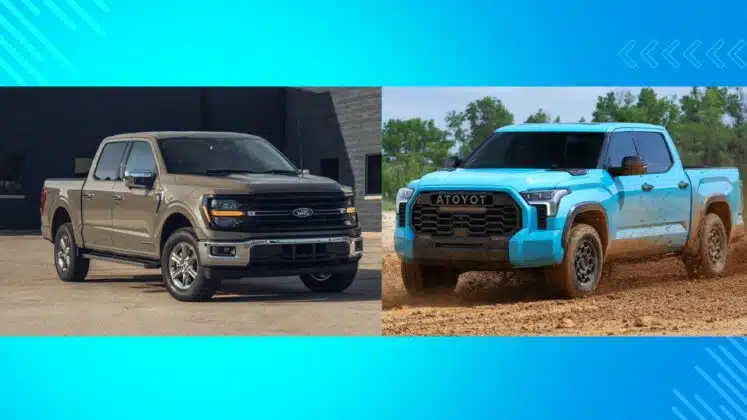
2026 Ford F150 vs 2026 Toyota Tundra
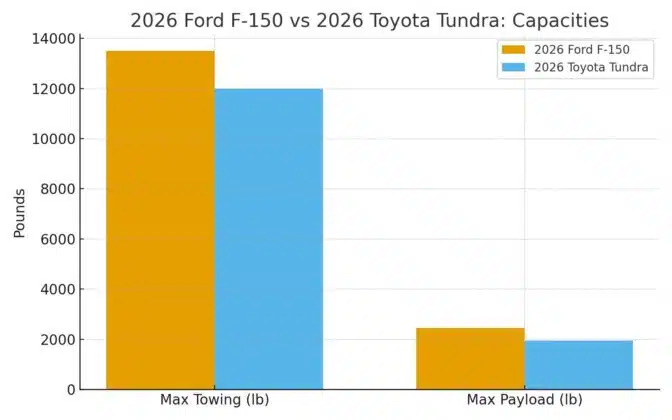
The 2026 Ford F150 offers up to 13,500 lbs of towing capacity and 2,445 lbs of payload, with multiple powertrains including hybrid and high-output V8 options. The 2026 Toyota Tundra, by contrast, tows up to 12,000 lbs and carries 1,940 lbs, powered by its twin-turbo V6 and hybrid i-Force MAX systems.
Both trucks feature advanced tech and comfort the F-150 adds BlueCruise hands-free driving and a 12-inch display, while the Tundra provides Toyota Safety Sense and premium Capstone interiors. In short, the F-150 delivers broader capability, while the Tundra excels in hybrid efficiency and refinement.
📊 Quick Spec Comparison Table
| Spec | 2026 Ford F-150 | 2026 Toyota Tundra |
|---|---|---|
| Engines / Power | 2.7L twin-turbo V6 (325 hp / 400 lb-ft) 3.5L twin-turbo V6 (400 hp / 500 lb-ft) High-output 3.5L (450 / 510) 5.0L V8 (400 / 410) Hybrid (3.5 + e-motor) 430 / 570 Raptor R: 5.2L supercharged ~720 / 640 | i-Force 3.4L twin-turbo V6 (389 hp / 479 lb-ft) Hybrid i-Force MAX (437 hp / 583 lb-ft) |
| Max Towing | ~ 13,500 lb (when properly equipped) | 12,000 lb (in proper configuration) |
| Max Payload | ~ 2,445 lb | 1,940 lb |
| Fuel Economy / MPG | 2.7L: ~ 18-19 / 23-25 mpg 5.0 V8: ~ 16 / 24 mpg 3.5 twin: ~ 16-17 / 24-25 mpg Hybrid: ~ 22 / 24 mpg High-output / Raptor variants: down toward ~ 10-14 / ~ 15-18 mpg | Official combined estimate ~ 20 mpg (gas baseline) in some trims |
| Bed Dimensions / Options | Depth 21.4 in, width between wheel wells ~ 51.1 in; bed length options: 5.5 ft, 6.5 ft, 8 ft; cargo volumes ~ 52.8 / 62.3 / 77.4 cu ft | Toyota hasn’t fully published new 2026 bed dimensions; carryover layouts expected (multiple bed lengths in Double Cab / CrewMax) |
| Trim Levels & Pricing | Precise 2026 pricing not fully public as of now; many trims expected (XL, XLT, Lariat, King Ranch, Platinum, Raptor, Raptor R, etc.) | Known trims include SR, SR5, Limited, Platinum, 1794, TRD Pro, Capstone; pricing range for 2026 expected to mirror current structure (e.g. up to ~$82,000) |
| Infotainment / Tech | 12-inch touchscreen standard, Apple CarPlay / Android Auto, BlueCruise hands-free highway system optional, camera / trailer-assist modes, advanced driver aids | Modern large display systems in upper trims, Toyota Safety Sense standard suite of driver aids, increased standardization of features (e.g. hitch & connectors now standard) |
| Safety & Driver Aids | Forward collision, automatic emergency braking, 360° camera with trailer-mode, possible lane keeping, etc. (Ford support site) | Toyota includes its usual comprehensive suite (lane assist, adaptive cruise, pedestrian detection, etc.) |
| Warranty / Maintenance | Manufacturer standard warranties (check local region) via Ford support pages | Toyota’s normal warranty structure (basic, powertrain, etc.), as per Toyota’s published policies |
🎨 Style, Design & First Impressions
Ford F-150: Bold but familiar
Ford gives the 2026 F-150 a refreshed look: sharper grille, more aggressive lighting signatures, new wheel styles and colors.
The overall silhouette remains true to its generation, but on closer look you’ll spot tweaks in fascia angles and trim accents.
The “Lobo” variant teased in spy shots hints at a street-leaning subvariant. Motor1.com Inside, drivers find a clean, modular layout with intuitive switchgear, multiple storage cubbies, and a bright, prominent 12-inch touchscreen front and center.
Toyota Tundra: Refined evolution
Toyota doesn’t reinvent the wheel for 2026, but refines it smartly.
The 2026 Tundra gets new aesthetic touches, fresh interior material combinations, and expanded standardization of features like trailer hitch and 4/7-pin connectors.
The Capstone trim picks up premium leather treatments (Shale color) in the cabin.
Car and Driver The body lines and overall truck shape remain familiar, but build quality, gaps, and finish appear sharper.
🔧 Engines, Performance & Transmissions
Ford’s wide powertrain palette
Ford aims to cover all bases. The 2026 F-150 lineup includes:
- 2.7L twin-turbo V6 — 325 hp, 400 lb-ft of torque.
- 3.5L twin-turbo V6 — 400 hp, 500 lb-ft.
- High-output 3.5L — tuned to ~ 450 hp and 510 lb-ft for sporty / Raptor trims.
- 5.0L naturally aspirated V8 — 400 hp and ~ 410 lb-ft.
- Hybrid (PowerBoost style) — pairing the 3.5L twin-turbo with electric assist, yielding ~ 430 hp, 570 lb-ft.
- Raptor R (supercharged 5.2L V8) — in the performance extreme category, Ford expects ~ 720 hp, 640 lb-ft (or close) in its high-strung trim.
All (or nearly all) are paired to a 10-speed automatic transmission and offered in either RWD or 4WD, depending on trim.
Ford claims a maximum towing capability of ~ 13,500 lb in suitably equipped versions, along with a top payload around 2,445 lb.
Fuel economy will vary by engine. Early published estimates:
- 2.7L: ~ 18-19 mpg city / 23-25 mpg highway
- 5.0L V8: ~ 16 city / 24 highway
- 3.5L twin: ~ 16-17 city / 24-25 highway
- Hybrid: ~ 22 city / 24 highway
- High-output / Raptor styles drop significantly, possibly into low teens range.
Toyota’s twin-turbo + hybrid strategy
Toyota’s 2026 Tundra leans heavily on advanced tuning and hybrid tech instead of sheer variety. Key engine options:
- i-Force twin-turbo 3.4L V6 (gas) — 389 hp, 479 lb-ft.
- i-Force MAX hybrid (3.4L twin + electric assist) — net 437 hp, 583 lb-ft torque, with peak torque arriving low (2,400 rpm) for strong towing punch.
Toyota holds its max rated towing at 12,000 lb in the best configurations. Payload is rated ~ 1,940 lb.
Fuel economy for the baseline gas engine is more modest; Toyota publishes a combined ~ 20 mpg figure in some trims. The hybrid variant helps offset that deficit, especially under load or highway use.
Toyota also increased standard features across trims: a larger 32.2-gallon fuel tank, improved standard hitch and connectors, and more baseline equipment.
Bed, Cargo & Dimensions
Ford F-150 bed & cargo
Every 2026 F-150 uses the same 21.4 in depth and ~ 51.1 in width between wheel wells. There are three bed lengths offered: 5.5 ft, 6.5 ft, or 8.0 ft. That translates to cargo volumes of ~ 52.8, 62.3, or 77.4 cubic feet, respectively.
Cabin-wise, the F-150 supports Regular Cab (3 seats), Super Cab (with small rear doors / bench), and SuperCrew (full-size rear doors with comfortable rear seating).
Toyota Tundra bed & cargo
Toyota has not fully confirmed updated 2026 bed measurements as of this writing.
The previous generation offered multiple bed lengths depending on cab style (Double Cab, CrewMax). The 2026 Tundra likely retains that flexibility.
For one published trim (2026 Tundra Limited), specs show a 65.6 in bed length (≈ 5.47 ft), payload 1,605 lb, and towing ~ 11,170 lb. Edmunds Earlier spec listings show Tundra with bed length ~ 77.6 in in some trims.
To be safe, plan that Toyota’s bed offering will be functionally competitive, though Ford’s wider established data gives more upfront confidence.
Interior & Comfort
Ford F-150 cabin experience
The 2026 F-150’s interior combines ruggedness with refinement. Soft-touch materials, clear instrument clusters, and purposeful design underscore its usability.
The standard 12-inch touchscreen anchors the dash. Smartphone integration (Apple CarPlay / Android Auto) is standard.
Available technologies include: BlueCruise semi-autonomous highway driving in permitted zones, advanced trailering / camera modes, and enhanced driver aids.
Storage is well thought out — under-seat bins, console cubbies, door map pockets, and modular trays.
Rear-seat space in SuperCrew variants is generous. The overall layout emphasizes visibility, comfort, and flexibility.
Toyota Tundra interior & usability
Toyota continues to build a cabin with durability and comfort.
Higher trims like Capstone and Limited gain premium leather, selectable color schemes, and nicer finishes.
The infotainment / control layout is clean, physical knobs and buttons remain for key functions, and the display in upper trims is modern and responsive.
Rear-seat ventilation, smarter HVAC logic, and more features have rolled into higher trims.
For families or crew riders, the Tundra offers solid comfort — though the exact legroom and width gains or deficits relative to F-150 depend on cab configuration.
🖥 Infotainment & Tech
- Ford F-150 uses a 12-inch touchscreen as baseline, with full smartphone integration, generous connectivity, and optional BlueCruise hands-free highway driving.
- Trailering and camera systems are heavily enhanced, with trailer-mode views, 360° camera, and smart assist features in higher trims.
- Toyota Tundra leverages Toyota’s “Tech + Safety” enhancements: large displays in upper trims, solid base level telematics, and the full Toyota Safety Sense driver assistance suite.
- In 2026, Toyota is making previously optional features more standard (e.g. hitch and wiring connectors, upgraded fuel tank capacity) to reduce buyer compromises.
If you link to external reviews or spec summaries (like the CarsDirect preview or MotorTrend deep dives), it gives your readers more context and credibility.
🛡 Safety, Driver Assistance & Warranty
Safety & Driver Aids
Both trucks pack modern safety systems:
- F-150: forward collision alert, automated emergency braking, trailer camera modes, possibly lane-keep, blind-spot, and other advanced driver aids (via Ford support pages).
- Tundra: Toyota’s driver assist suite—adaptive cruise, lane keep, blind spot, pedestrian detection, etc.—is strong, often standard or widely available.
- New for 2026, Toyota makes the trailer hitch and 4/7-pin connector standard across trims, reducing blind spots in feature gaps.
Warranty & Maintenance
- Ford: standard limited and powertrain warranties apply. The Ford Owner Support pages list maintenance and service programs for F-150 2026.
- Toyota: standard Toyota warranties for basic, powertrain, corrosion, etc., as per region. Their press materials and Toyota.com pages reflect continuity on this front.
You may want to add region-specific warranty terms (Canada, US) from TruckReportGeeks’ policies or local dealers to strengthen your article.
🧭 Rival Context: Ram 1500, Sierra/Silverado
To broaden your coverage (and catch long-tail traffic), here’s a quick look at how both these trucks stack up with major competitors:
- Ram 1500: Known for exceptional ride quality (air suspension), interior luxury, and optional diesel engine. Its towing may not match the top F-150 or Tundra hybrids, but for users valuing comfort, Ram appeals.
- Chevrolet Silverado / GMC Sierra 1500: Strong in engine breadth (including diesel), robust towing across trims, generous bed layouts, and tech features. Their off-road / AT4 / ZR2 variants push into performance space.
You could insert a sidebar in your magazine layout titled “How the F-150 & Tundra stack vs Ram/Sierra” to catch those comparison searches.
Q&A (Before You Decide)
Which gives better real-world towing under load?
While F-150 claims a higher max tow (13,500 lb vs Tundra’s 12,000 lb), the difference in real-world conditions often narrows due to cooling, gearing, cargo, and driver aids. If you tow near maximum often, F-150’s margin gives cushion; if you tow moderately, both will perform capably.
How will fuel economy differ dramatically?
When lightly loaded, the hybrid variants of both (or in F-150’s case) offer much smoother highway consumption. Under heavy load or steep grades, the Tundra hybrid’s torque advantage may help. But in city or mixed use, Ford’s variety allows you to pick an engine that matches your use (e.g. 2.7L vs V8), which gives flexibility.
Which has better resale or brand reliability?
Toyota has strong brand perception for long-term durability. Ford has deep service networks and strong parts support. Over a 10- to 15-year horizon, real world conditions (maintenance, use case) will likely matter more than small spec gaps.
Are there eco / hybrid plans further ahead for Tundra?
Toyota’s hybrid move for 2026 with i-Force MAX hints strongly that they intend further electrification in coming years. Watch for possible plug-in hybrid or full electric Tundra models down the line.
Which should you buy?
If your priority is tow ceiling, option flexibility, and bleeding-edge driver-assist, lean F-150. If you value fully integrated hybrid torque, brand durability, and a simpler powertrain offering, Tundra may appeal. The “right pick” often comes down to your particular use case (payload, terrain, resale).
🏁 Conclusion & Editorial Take
This is the dawn of a new era in full-size pickups.
The 2026 Ford F-150 pushes hard into versatility — more engines, more configurations, stronger tech.
The Toyota Tundra bets on refinement, hybrid integration, and making strong features more standard across trims.
If your world revolves around heavy towing, occasional performance driving, or you want a “build to spec” machine, Ford’s suite gives you latitude.
If reliability, seamless hybrid torque, and fewer compromises in mid and upper trims appeal more, the Tundra is a compelling counterpunch.
From a magazine’s vantage, the new F-150 is your wide-spectrum Swiss Army knife; Tundra is the refined, efficient workhorse that’s smart about where it leans in.
If you enjoyed this deep dive, please like and comment – share your own experiences or spec wishes. Let the TruckReportGeeks audience grow.