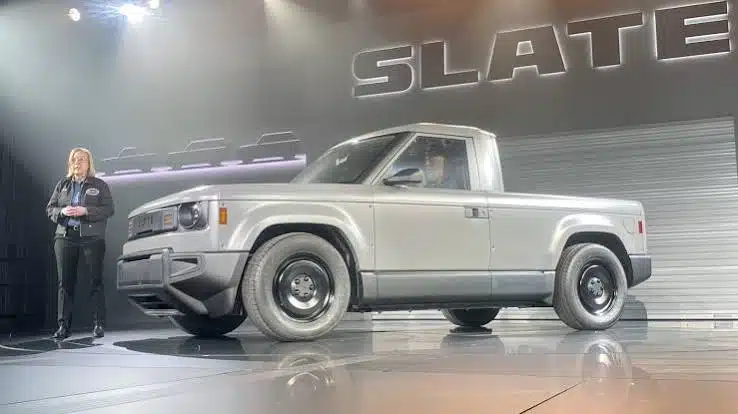
2027 Slate Truck
The pickup truck market has a problem: new trucks have become expensive.
Walk into a dealership looking for a new full-size pickup, and it doesn’t take long to discover how quickly the price can climb. Even smaller trucks are no longer the inexpensive work vehicles they once were.
Now a new company called Slate Auto is taking a very different approach.
Instead of building another luxury electric pickup loaded with giant screens, complicated technology and expensive features, Slate wants to offer something much simpler: a small, two-seat electric pickup that starts at $24,950 before destination charges, taxes and other fees.
It’s called the 2027 Slate Truck, and it could become one of the most unusual additions to the North American truck market.
But there is a bigger question than its starting price.
Can a small electric pickup with rear-wheel drive, an estimated 205-mile range and a 2,000-pound towing capacity actually deliver what everyday truck buyers need?
Let’s take a closer look at what Slate is building, what it offers, where it falls short, and who might want to consider buying one.
What Is the 2027 Slate Truck?
The Slate Truck is a compact, battery-electric pickup developed by Slate Auto, an American startup backed by investors that include Jeff Bezos.
Its approach is almost the opposite of what many automakers have been doing.
Today’s trucks are increasingly packed with large infotainment displays, power-operated equipment, advanced driver assistance systems and luxury interiors.
Slate is stripping much of that away.
The basic truck is designed around two seats, a simple dashboard, physical controls, manual windows and a straightforward electric powertrain.
There is no conventional built-in infotainment touchscreen in the basic configuration. Instead, the idea is to let owners use their own devices and add accessories as needed.
Slate is also designing the vehicle to be changed after purchase. Buyers can start with the pickup and later add conversion equipment that turns it into a five-seat SUV-style vehicle.
That modular approach is a major part of the company’s business plan.
Rather than making customers pay for equipment they may never use, Slate wants buyers to purchase the basic vehicle and personalize it over time.
It is an interesting idea, especially for people who want a practical vehicle without paying for features they don’t need.
How Much Does the 2027 Slate Truck Cost?
Price is probably the biggest reason people are paying attention to Slate.
The company lists the basic Blank Slate Truck at $24,950 USD.
However, that isn’t the full delivered price.
Slate lists a $1,450 destination charge, bringing the starting figure to approximately $26,400 USD before taxes, registration and other applicable fees.
That distinction matters because the original attention surrounding Slate came from the promise of an electric pickup that could cost less than $20,000.
That early figure depended on a federal electric-vehicle tax credit that is no longer available. Buyers should not assume they can purchase this truck for under $20,000.
The SUV conversion models also start higher. Slate lists its Squareback and Fastback configurations from $29,950 before destination charges and other fees.
The company uses a direct-to-consumer sales model rather than relying on the traditional dealership system.
Customers can place a preorder with a $300 deposit, which Slate says is applied toward the purchase price. Its preorder terms state that the deposit is generally non-refundable, subject to the limited exceptions in the agreement.
That is something potential buyers should read carefully before placing an order.
You can check the company’s current pricing and ordering details through the official Slate Auto website.
Slate Truck Engine, Power and Performance
The Slate Truck doesn’t have a traditional engine.
It uses a single electric motor mounted at the rear, sending power to the rear wheels.
Here are the manufacturer’s published estimates:
| Specification | 2027 Slate Truck |
|---|---|
| Powertrain | Single electric motor |
| Horsepower | 181 hp |
| Torque | 195 lb-ft |
| Drivetrain | Rear-wheel drive |
| Battery | 65-kWh LFP |
| Usable battery capacity | 63 kWh |
| Estimated 0–60 mph | 8.0 seconds |
| Estimated top speed | 90 mph |
| Transmission | Single-speed electric drive |
The numbers tell us something important about the Slate.
This isn’t being developed as a performance pickup.
It isn’t designed to compete with a Ford F-150 Lightning, Rivian R1T or a high-performance gas-powered truck.
The idea is to provide enough power for everyday transportation, local hauling and light-duty work.
The rear-wheel-drive layout also keeps the mechanical setup relatively simple.
For someone driving around town, visiting job sites, making hardware-store runs or commuting to work, that may be perfectly adequate.
But buyers who regularly travel through deep snow, muddy work sites or rough terrain will need to think carefully about the lack of four-wheel drive.
Battery Range and Charging
Slate lists a 65-kWh lithium iron phosphate battery, with approximately 63 kWh of usable energy.
The company estimates the pickup will travel approximately 205 miles on a full charge.
That is a manufacturer projection based on an approximation of the EPA test cycle. It is not an official EPA-rated range figure.
Real-world range will depend on weather, driving speed, road conditions, tire selection, accessories and how the vehicle is used.
That is especially important with an electric pickup.
Cold temperatures can reduce battery performance, and carrying heavy loads or towing a trailer can reduce driving range considerably.
For charging, Slate lists the following estimated figures:
| Charging Type | Manufacturer Estimate |
|---|---|
| Level 1 AC, 20–80% | 17 hours |
| Level 2 AC, 20–100% | 4 hours |
| DC fast charging, 20–80% | 30 minutes |
| Maximum listed DC charging power | 120 kW |
| Charging connector | NACS |
The truck also uses the North American Charging Standard, commonly associated with Tesla’s charging network.
That gives the Slate access to compatible charging infrastructure, subject to station availability and vehicle compatibility.
For someone who can charge at home overnight, a projected 205-mile range could be enough for many daily driving routines.
For people who regularly drive long distances, travel between rural communities or tow equipment, charging stops and reduced range will need to be part of the decision.
Towing and Payload: Is the Slate Really a Work Truck?
This is where truck buyers need to pay close attention.
Slate lists a maximum towing capacity of 2,000 pounds for the pickup.
Its projected maximum payload is 1,550 pounds.
Those figures make it useful for some light-duty jobs, but they put the Slate in a completely different category from conventional midsize and full-size pickups.
| Capability | 2027 Slate Truck |
|---|---|
| Maximum towing | 2,000 lbs |
| Maximum payload | 1,550 lbs |
| Bed length | 60.5 inches |
| Bed length with tailgate down | 80.7 inches |
| Bed volume | 35.1 cubic feet |
| Frunk storage | 7.0 cubic feet |
The five-foot bed is useful for everyday hauling.
It can accommodate many home-improvement materials, outdoor equipment, tools and weekend projects.
But the 2,000-pound towing rating is not enough for many of the trailers that pickup owners regularly pull.
A small utility trailer, lightweight landscaping trailer or some recreational equipment may fit within the rating.
A larger travel trailer, heavy boat or equipment trailer is a different story.
And remember: towing capacity is not the same as payload capacity.
The weight of passengers, cargo and trailer tongue load all count toward the vehicle’s weight limits. Buyers must follow the final vehicle’s door-jamb ratings and the trailer manufacturer’s requirements.
The Slate may be a useful little hauler, but it isn’t a replacement for an F-150, Silverado 1500, Ram 1500 or a properly equipped midsize truck for serious towing.
How Big Is the Slate Truck?
One of the most interesting things about the Slate is its size.
It is considerably smaller than the full-size pickups that dominate the North American market.
| Exterior Dimension | Slate Truck |
|---|---|
| Overall length | 174.6 inches |
| Wheelbase | 108.9 inches |
| Width without mirrors | 70.6 inches |
| Width with mirrors | 78.1 inches |
| Height | 68.0 inches |
| Ground clearance | 7.8 inches |
| Bed length | 60.5 inches |
| Turning circle | 37 feet |
The compact dimensions should make it easier to maneuver and park than a full-size pickup.
That could be an advantage for people living in cities, working in crowded commercial areas or dealing with tight residential driveways.
The bed is also more useful than its compact exterior might suggest.
Slate lists 35.1 cubic feet of bed volume, with a 60.5-inch bed length and a tailgate that extends the usable length to 80.7 inches.
It won’t replace a long-bed work truck, but it gives owners a practical open cargo area.
Interior: No Big Screen, No Fancy Dashboard
The interior is one of the biggest talking points.
Slate isn’t trying to impress buyers with a giant touchscreen or a dashboard covered in digital displays.
The company is going in the opposite direction.
The basic vehicle is designed with physical controls, a simple instrument display, manual windows and a straightforward cabin.
There is no conventional built-in infotainment touchscreen in the basic truck.
Some buyers will love that.
Others will wonder why they should spend more than $26,000 on a new vehicle that doesn’t include features they have come to expect as standard equipment.
But that is the trade-off Slate is making.
The company believes many customers would rather pay less upfront and add the features they actually want.
Slate’s accessories marketplace is intended to make that possible.
The important thing for buyers is to compare the cost of the truck after adding the equipment they want, not just the advertised base price.
A low starting price can become less attractive if the accessories needed to make the vehicle comfortable and practical push the final cost significantly higher.
The Slate Truck Can Become an SUV
This is probably the most unusual feature of the entire project.
Slate plans to offer conversion options that allow owners to change the basic two-seat pickup into a five-seat SUV-style vehicle.
The two main configurations are called Squareback and Fastback.
The Squareback has a more traditional SUV shape, while the Fastback uses a sportier rear profile.
There is also an Open Air configuration and a Cargo Kit in the company’s published body-style options.
The concept is simple.
You buy the vehicle you need today, and if your needs change later, you can change the body configuration instead of replacing the entire vehicle.
For a small business owner, that flexibility could be appealing.
Someone might begin with the pickup for work and later convert it into a passenger vehicle.
However, buyers should check the final price of each conversion kit, installation requirements, warranty coverage and how the conversion affects payload and towing ratings.
The pickup and SUV configurations do not have identical specifications.
For example, Slate lists the SUV configuration with a projected 1,263-pound payload and 1,824-pound towing capacity, compared with 1,550 pounds of payload and 2,000 pounds of towing for the pickup.
Safety Features
A low starting price doesn’t mean safety should be overlooked.
Slate says the vehicle is being designed to achieve a five-star U.S. NCAP crash rating.
That is a design target, not an achieved crash-test result.
The company’s published safety equipment includes features such as:
- Traction control
- Electronic stability control
- Forward collision warning
- Automatic emergency braking
- Backup camera
- Pedestrian identification
- Automatic high beams
- Front airbags
- Side curtain airbags
Buyers should wait for official crash-test results and final production equipment details before treating the truck as having a confirmed five-star rating.
It is also worth remembering that a simple interior does not automatically mean a vehicle is less safe.
What matters is how the finished vehicle performs in independent testing and which safety systems are included in the production model.
Where Is the Slate Truck Built?
Slate says its vehicles are designed in California and Michigan, engineered in Michigan and assembled in Indiana.
The company’s manufacturing plans are an important part of the story.
Slate is a new automaker, and building a prototype is very different from producing thousands of vehicles consistently.
According to a November 5 report from Business Insider, Slate’s tire supplier indicated that production units were expected to enter production during November 2026.
The company has previously said first deliveries are expected in late 2026.
That means the next major test is not simply whether Slate can build a working electric pickup.
It is whether the company can ramp up production, meet quality expectations, deliver vehicles on schedule and support customers after the sale.
That is a substantial challenge for any new automaker.
Will the Slate Truck Be Available in Canada?
Canadian buyers may be interested in the Slate, especially if they are looking for a smaller electric vehicle for commuting, light hauling and everyday use.
But there is an important distinction between a vehicle being announced for the North American market and being available for purchase in Canada.
Slate’s published preorder terms currently specify that preorders are available to residents of the United States.
The company has not established a confirmed Canadian retail launch, Canadian pricing or a Canadian delivery schedule in the information cited here.
Canadian buyers should also consider winter driving, cold-weather range, charging availability, service support and parts availability before getting too excited.
A projected 205-mile range is not a promise of 205 miles in a Canadian winter.
Until Slate confirms Canadian availability and provides final specifications for vehicles sold here, Canadian shoppers should treat the truck as a U.S.-market opportunity rather than an available Canadian purchase.
How Does the Slate Compare With Other Small Trucks?
The Slate is not a direct replacement for every small pickup.
It is a compact electric vehicle with a very different mission from conventional gas-powered trucks.
The Ford Maverick, for example, offers a more conventional cabin, gasoline and hybrid powertrain options, and a higher towing capability in properly equipped configurations.
The Hyundai Santa Cruz is another alternative for buyers who want a smaller vehicle with an open bed.
The Slate’s advantage is its electric powertrain, modular design and low advertised starting price.
Its disadvantages are its limited towing capacity, rear-wheel-drive-only layout, projected range and stripped-down standard equipment.
Here is the basic difference:
| Truck | Main Appeal | Important Consideration |
|---|---|---|
| Slate Truck | Low-cost electric pickup and customization | 2,000-lb towing projection |
| Ford Maverick | Conventional compact pickup with gas and hybrid choices | Configuration affects towing |
| Hyundai Santa Cruz | Compact pickup-style utility vehicle | Not a traditional body-on-frame truck |
| Full-size pickups | Greater towing, payload and capability | Generally much higher purchase prices |
The Slate isn’t trying to win a towing contest.
It is trying to attract buyers who don’t need a big truck in the first place.
Who Should Consider Buying a Slate Truck?
I can see several groups of buyers who might find the Slate interesting.
City drivers: Its compact dimensions could make it easier to park and maneuver than a full-size pickup.
Homeowners: The bed could be useful for garden supplies, tools, small furniture and hardware-store purchases.
Small businesses: Contractors and service businesses that need light-duty transportation may find the basic layout appealing, provided the payload and towing limits fit their work.
Commuters: People with predictable daily driving and home charging could make good use of its projected electric range.
EV buyers on a budget: Someone who wants an electric vehicle but doesn’t need luxury features may appreciate the simplified approach.
But there are also buyers who should probably look elsewhere.
If you regularly tow a travel trailer, haul heavy equipment, drive long rural routes or need four-wheel drive, the Slate’s specifications may not be enough.
And if you want a comfortable family vehicle with a full rear seat right away, remember that the basic pickup starts as a two-seat truck. The SUV conversion adds capability but also adds cost.
2027 Slate Truck Frequently Asked Questions
How much does the 2027 Slate Truck cost?
The basic Slate Truck starts at $24,950 USD before the $1,450 destination charge, taxes and other fees. That makes the starting price approximately $26,400 before those additional costs.
How far can the Slate Truck travel on a charge?
Slate estimates approximately 205 miles of range. This is a manufacturer projection, not an official EPA-rated range figure.
How much can the Slate Truck tow?
The pickup has a projected maximum towing capacity of 2,000 pounds. The SUV configuration is listed at 1,824 pounds.
How much payload can the Slate carry?
Slate lists a projected maximum payload of 1,550 pounds for the pickup and 1,263 pounds for the SUV configuration.
Does the Slate Truck have four-wheel drive?
No. The published configuration uses a single electric motor driving the rear wheels.
Does the Slate Truck have a touchscreen?
The basic truck is designed without a conventional built-in infotainment touchscreen. It uses a simpler dashboard and physical controls.
Can the Slate Truck become an SUV?
Yes. Slate plans to offer conversion kits that change the two-seat pickup into a five-seat Squareback or Fastback SUV-style vehicle.
Is the Slate Truck available in Canada?
Slate’s published preorder terms currently restrict preorders to U.S. residents. Canadian pricing, ordering and delivery availability have not been confirmed in the information covered here.
When will the Slate Truck be delivered?
Slate has said first deliveries are expected in late 2026. Production timing has been reported for November 2026, but actual customer deliveries and production ramp-up will determine how quickly buyers receive their vehicles.
Final Thoughts: Could the Slate Truck Be the Pickup Buyers Have Been Waiting For?
I think the Slate Truck is one of the more interesting pickup projects to come along in a long time.
Not because it can tow 10,000 pounds.
Not because it has 500 horsepower.
And certainly not because it offers a luxury interior.
It is interesting because it challenges the idea that every new pickup has to be bigger, more powerful, more expensive and packed with technology.
There are plenty of people who don’t need a full-size truck.
They need something to get to work, carry tools, haul supplies, pick up materials and handle everyday jobs.
For those buyers, a simple electric pickup with a starting price around $26,400 before taxes and fees could be worth a serious look.
But the Slate also has some real limitations.
A 2,000-pound towing rating won’t satisfy many traditional truck owners. Rear-wheel drive won’t be ideal for everyone. And the projected 205-mile range needs to be evaluated against real-world driving, especially in cold climates.
The biggest question is whether Slate can deliver the finished vehicle at the promised price, build it in meaningful numbers and support customers after they take delivery.
That is what will ultimately decide whether this becomes a successful new truck or simply another interesting idea.
What do you think? Would you buy a basic electric pickup for around $26,400, or would you rather spend more money on a conventional gas-powered truck with greater towing and hauling capability?
That’s a question worth discussing, because the Slate Truck is betting that a lot of people are ready to go back to basics.