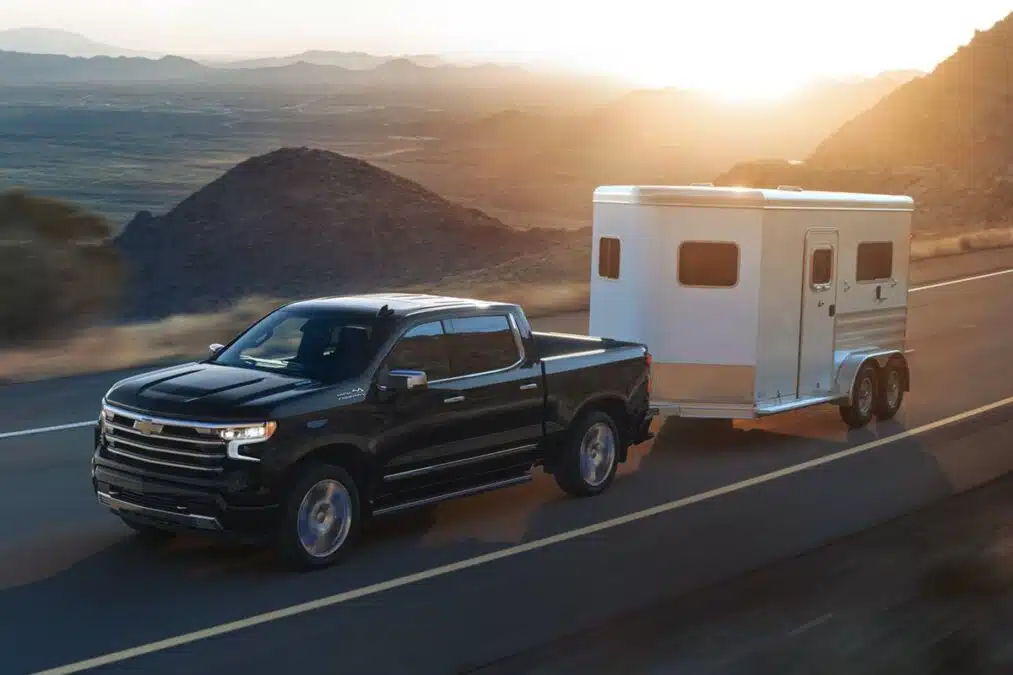
Silverado 1500 Max Trailering Package
Yes—Max Trailering (RPO NHT) is worth it if you are trying to reach the higher towing “rows” (often 11,000–13,300 lbs depending on engine/config) or you tow heavy often enough that the upgraded axle/suspension/cooling package is a real durability and stability benefit.
No—it’s usually not worth it if your trailer is modest (typical utility trailer, small camper) and you’re not operating near the truck’s limits, because payload and tongue weight will still be your real constraint.
📊 What Max Trailering (NHT) does in the real world
Chevy’s official Max Trailering chart and GM Authority’s towing tables show that NHT is required on many of the higher-rated combinations, and some of the very top ratings also require 20-inch wheels.
The “NHT jump” is not marketing—it’s in the tables
A GM Authority example row set shows a Double Cab Standard Bed 2WD moving from the “regular” tow rating to a much higher one with NHT, including a max line that also carries a 20-inch wheel requirement footnote on certain max rows.
Chevy’s 2025 Max Trailering chart explicitly includes footnotes such as “Requires available Max Trailering Package” and “Requires available Max Trailering Package and 20-inch wheels” on specific maximum lines.
🔧 What’s included in Max Trailering (NHT)
Exact content can vary by configuration/engine, but published package summaries consistently describe NHT as a hardware upgrade, not a software mode.
Commonly listed NHT components include:
- 9.76-inch rear axle
- Revised axle ratio (often 3.42 on gas, 3.73 on Duramax in package summaries)
- Enhanced cooling
- Heavier-duty rear springs / increased rear axle rating (RGAWR) content
- Revised shock tuning / trailering suspension content
- Integrated trailer brake controller
Important: Tow/Haul mode is separate—it changes driving behavior. NHT changes the truck’s towing hardware and table eligibility.
✅ When Max Trailering is worth it
1) You want the highest published tow ratings
If your goal is the “top of the chart” conventional tow numbers, you’re frequently shopping a build that is explicitly called out as:
- Requires Max Trailering (NHT), and sometimes
- Requires Max Trailering (NHT) + 20-inch wheels
That alone can justify the option—because without it, you simply may not qualify for the higher-rated configuration row.
2) Your trailer is heavy enough to stress the truck repeatedly
If you tow heavy often (work trailer, larger travel trailer), the NHT package’s axle/suspension/cooling upgrades can be a practical durability and stability decision—not just “more number.”
3) You’re trying to avoid upgrading to a 2500HD
For some owners, NHT is the “last stop” before jumping to HD. If you can stay inside your payload/axle limits while meeting your trailer needs, NHT can keep you in a 1500.
❌ When Max Trailering is not worth it
1) You are payload-limited (most half-ton owners)
Chevy’s trailering guide states conventional trailer tongue weight should be 10% to 15% of loaded trailer weight, and that you may need to reduce trailer weight to stay within GCWR, GVWR, max tongue load, or RGAWR.
That means if your real limiting factor is payload (tongue weight + passengers + gear), NHT may not solve the actual problem.
2) Your trailer is modest
If you tow a smaller utility trailer, a small boat, or a lighter camper, you often won’t live in the “NHT required” part of the towing tables.
🧮 The simple math you must do before spending the money
Chevy states:
- Conventional tongue weight should be 10% to 15% of loaded trailer weight.
- You may have to reduce trailer weight to stay within GCWR/GVWR/RGAWR and max tongue load.
Fast planning rule:
Tongue weight ≈ Loaded trailer weight × 0.10 to 0.15.
If you’re towing 8,000 lbs loaded, that’s often 800–1,200 lbs on the hitch—before passengers and cargo.
✅ Decision checklist (buy NHT only if you check these boxes)
- Your trailer’s loaded weight puts you near the higher towing rows, and those rows show NHT required (or NHT + wheel requirement).
- You tow heavy frequently, not just once a year.
- You’ve run the payload math and you are not already payload/RGAWR limited.
- You are willing to match the full “tow row” requirements (engine + drivetrain + axle ratio + package + sometimes wheels).
- 2025 Silverado 1500 Max Trailering chart (official) Chevrolet
- 2025 Silverado 1500 towing tables + NHT footnotes GM Authority
- 2025 Chevrolet Trailering Guide (weight ratings + tongue weight) Chevrolet
❓ FAQs
Does Max Trailering (NHT) automatically mean I can tow 13,000+ lbs?
No. NHT is often required for the highest rows, but your max tow rating still depends on engine, cab/bed, drivetrain, axle ratio, and sometimes wheel requirements.
Is NHT the same as Tow/Haul mode?
No. Tow/Haul is a driving mode. NHT is a hardware/capability package tied to higher-rated tow rows.
Will NHT fix payload limitations?
Not necessarily. Chevy’s guide emphasizes staying within GVWR/RGAWR and using proper tongue weight (10–15%). Payload is still the common bottleneck
🏁 Conclusion
Max Trailering (NHT) is worth it when you’re intentionally shopping the higher towing rows (and are willing to meet the full requirements), or when you tow heavy enough that the axle/suspension/cooling upgrades pay off in stability and durability.
If you’re mainly towing lighter trailers, spend the money on the right hitch setup, brake controller strategy, and a payload-accurate trailer match instead.
Like and comment with your Silverado 1500 engine, cab/bed, 2WD/4WD, whether you have NHT, and your wheel size (18 vs 20). I’ll tell you whether NHT changes your towing “row” enough to be worth it for your exact trailer weight and visit us again at Truck Report Geeks