
What’s the Difference Between Payload and Towing Capacity
When shopping for a truck, payload and towing capacity are two specs you’ll see everywhere — but they’re not the same thing.
Understanding the difference is critical if you want the best truck for your needs, whether you’re hauling lumber in the bed or pulling a camper cross-country.
This guide from TruckReportGeeks.com will break it down, compare specs, and help you choose with confidence.
🔍 Quick Comparison: Payload vs. Towing Capacity
| Feature | Payload Capacity 🛻 | Towing Capacity 🚛 |
|---|---|---|
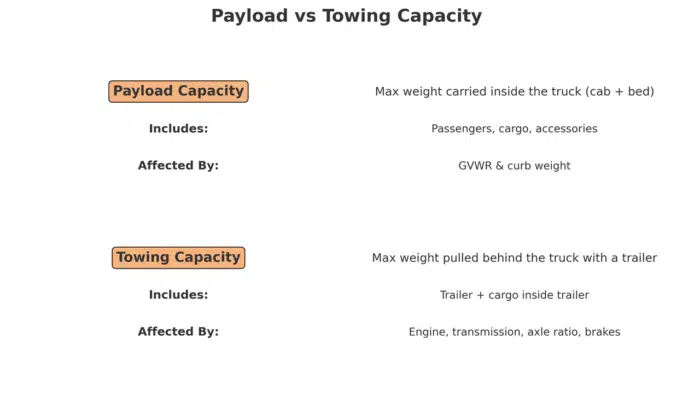
| Definition | Max weight a truck can carry in the cab & bed | Max weight a truck can pull with a trailer |
| Includes | Passengers, cargo, accessories | Trailer + cargo inside trailer |
| Measured In | Pounds (lbs) | Pounds (lbs) |
| Affected By | GVWR & curb weight | Engine, transmission, axle ratio, brakes |
| Best For | Worksite loads, camping gear, building materials | Boats, RVs, heavy equipment |
| Example (Half-Ton) | ~1,500–2,300 lbs | ~7,000–13,500 lbs |
⚙ Engine, Performance & Transmission Options
A truck’s engine and transmission play a major role in both payload and towing capacity.
- Gas engines usually offer lighter curb weight (higher payload) but may have lower towing torque.
- Diesel engines deliver more torque, ideal for heavy towing, but can reduce payload due to extra engine weight.
- Transmission gearing — A 10-speed automatic like in the 2025 Ford F-150 PowerBoost Hybrid can help optimize both hauling and pulling power.
We have a Truck Payload and Towing Calculator for you to use as well.
📏 Payload Capacity Explained
Payload capacity is determined by subtracting your truck’s curb weight from its gross vehicle weight rating (GVWR).
For example: If your truck has a GVWR of 7,000 lbs and weighs 5,000 lbs empty, your payload capacity is 2,000 lbs.
This includes passengers, tools, cargo in the bed, and any add-ons like ladder racks or campers.
🚛 Towing Capacity Explained
Towing capacity depends heavily on:
- Engine torque
- Axle ratio
- Chassis strength
- Cooling systems
A properly equipped half-ton pickup can tow between 7,000 and 13,500 lbs, while heavy-duty trucks like the Ford F-350 can exceed 35,000 lbs with a gooseneck hitch.
Want to compare towing across all brands? TruckReportGeeks.com’s towing capacity chart lays it out clearly.
⛽ Fuel Economy
Higher payload and towing loads increase engine strain, reducing fuel economy.
Light-duty trucks generally achieve 18–26 mpg, while heavy-duty towing often drops below 12 mpg.
The EPA’s official fuel economy database is a great resource for side-by-side comparisons.
🚛 Interior Comfort & Cargo Space
Modern trucks blend capability with comfort:
- Crew cab models offer 40+ inches of rear legroom
- Premium trims feature leather seating, heated/ventilated seats, and noise-reducing glass
- Bed sizes range from 5.5 ft to 8 ft long, with widths around 65 inches between wheel wells
💻 Infotainment & Tech
Expect features like:
- Apple CarPlay & Android Auto
- Wireless charging
- Built-in trailer brake controllers
- 360-degree camera systems
🛡 Safety Features
Most new trucks offer:
- Adaptive cruise control
- Trailer sway control
- Blind-spot monitoring (with trailer coverage)
- Lane-keeping assist
🛠 Warranty & Maintenance
Typical coverage:
- 3-year / 36,000-mile bumper-to-bumper
- 5-year / 60,000-mile powertrain
- Diesels may have extra emission system warranties
❓ FAQs
Can I increase my truck’s payload capacity?
No — GVWR is set by the manufacturer. Adding suspension helpers can improve handling, but it won’t legally change the rating.
Does a higher axle ratio help towing?
Yes — it increases pulling power but may reduce fuel economy.
Why does a heavier truck sometimes have lower payload?
More curb weight leaves less room under GVWR for payload.
Final Thoughts
Understanding the difference between payload capacity and towing capacity can save you from costly mistakes and ensure you get a truck suited to your needs.
For more in-depth truck guides, visit the truck research hub at TruckReportGeeks.com.
If you found this guide useful, please like and leave a comment below — your feedback helps us create even better truck resources.