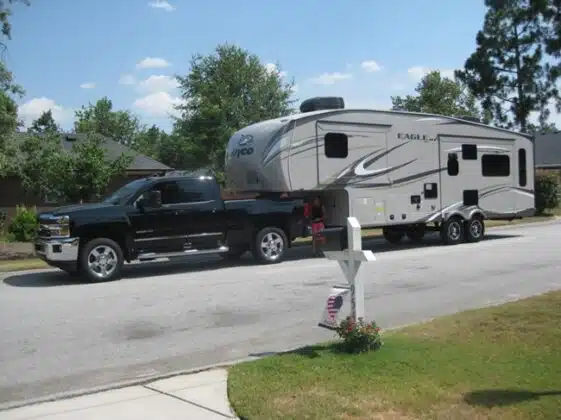
Payload Requirements for Fifth Wheel Trailers
If you’re planning to tow a fifth wheel trailer, one of the most important things you need to understand isn’t just how much your truck can pull it’s how much it can carry.
That’s where payload requirements for fifth wheel trailers come in, and ignoring them is one of the most common mistakes RVers make.
In this guide, you’ll get a clear, no-nonsense breakdown of payload, how it affects your towing setup, how to calculate what you need, and how to avoid overloading your truck.
Truck & Fifth Wheel Compatibility: Quick Comparison Table
| Fifth Wheel Type | Average GVWR | Estimated Pin Weight | Truck Class Needed |
|---|---|---|---|
| Lightweight/Compact | 7,000–9,000 lbs | 1,200–1,800 lbs | ¾-ton with high payload |
| Mid-size | 10,000–12,000 lbs | 2,000–2,800 lbs | Strong ¾-ton or entry 1-ton |
| Full-size Residential | 13,000–16,000+ lbs | 2,800–3,500+ lbs | 1-ton or dually (DRW) |
This table gives you a fast idea of what kind of truck you’ll likely need for your fifth wheel setup. The heavier the trailer, the more pin weight will press into the bed of your truck and that’s what eats up your payload capacity.
What Is Payload, Really?
Payload is how much weight your truck can carry in its cab and bed. That includes:
- People inside the cab
- Cargo (tools, gear, coolers, etc.)
- The fifth wheel hitch
- And most importantly… the pin weight (aka hitch weight) of your fifth wheel
If you go over that payload number, you’re stressing your suspension, tires, and brakes potentially making your setup dangerous and even voiding your truck warranty.
To better understand how payload compares to towing, Ram’s Towing & Payload 101 Guide explains it clearly using real-world examples.
Towing Capacity vs Payload Capacity
A lot of people confuse these two. Your towing capacity is the total amount your truck can pull behind it.
Your payload capacity is how much weight can be carried on the truck including everything in the cab and bed.
For fifth wheel trailers, payload is almost always more important because the trailer weight transfers into your bed, not just behind the bumper.
Ford’s towing page gives helpful visuals showing where to find your actual payload sticker on the truck door jamb. That number is real not a brochure guess.
How Much Payload Do You Really Need?
Most fifth wheel trailers place 15% to 25% of their total weight directly onto your truck bed as pin weight.
Simple Payload Calculation Formula:
(Trailer GVWR x 0.20) + Hitch Weight + Passengers + Cargo = Minimum Required Payload
Example:
- Trailer GVWR: 12,000 lbs
- Pin Weight (20%): 2,400 lbs
- Hitch: 200 lbs
- Passengers + Gear: 400 lbs
= 3,000 lbs required payload capacity
If your truck only has a payload of 2,100 lbs (common in half-ton pickups), you’re already overloaded.
Pin Weight Matters More Than You Think
Pin weight is the pressure the fifth wheel exerts on your truck’s bed. It’s different from tongue weight on a bumper-pull trailer.
Pin weight is typically 20% of the trailer’s total loaded weight, and it’s often the number that maxes out your payload capacity first.
Real-World Towing Scenarios
Can I Tow This?
Here are three quick scenarios to help you picture payload requirements in action:
- Scenario 1: A Ram 2500 with 3,200 lbs payload rating towing a 10,000-lb fifth wheel → ✅ Safe
- Scenario 2: A Ford F-150 with 2,000 lbs payload trying to tow a 12,500-lb fifth wheel → ❌ Not safe
- Scenario 3: A Silverado 3500 dually with 6,000 lbs payload and a 15,000-lb fifth wheel → ✅ Ideal match
These types of setups often confuse buyers because the trailer is within towing limits but not within payload limits.
Truck Payload Ratings: Rough Guidelines
| Truck Class | Average Payload Capacity | Best For |
|---|---|---|
| Half-ton (F-150, 1500) | 1,500–2,300 lbs | Very light fifth wheels (rarely recommended) |
| Three-quarter-ton (F-250, 2500) | 2,800–4,000+ lbs | Mid-size fifth wheels |
| One-ton (F-350, 3500 SRW) | 4,000–5,800 lbs | Full-size or heavier fifth wheels |
| One-ton Dually (3500 DRW) | 5,500–7,500+ lbs | Large luxury or residential fifth wheels |
To further explore real safety guidance from towing experts, check out the RV Safety & Education Foundation—they offer unbiased info and host seminars across North America.
Can I tow a fifth wheel with a half-ton truck?
Only very light fifth wheels specifically designed for half-tons. Even then, you’ll be at the edge of your payload. Always check the truck’s payload sticker before deciding.
What happens if I exceed payload capacity?
You risk poor braking, squatted suspension, premature tire wear, and increased risk of accidents. It can also void your warranty and insurance coverage.
How do I find my exact payload number?
Look inside the driver-side door jamb for a yellow sticker. It will list the “maximum combined weight of occupants and cargo.” That’s your truck’s real-world payload not just a spec sheet number.
Does diesel vs gas affect payload?
Yes. Diesel trucks weigh more, so they usually have lower payload ratings than their gas-powered counterparts even if they tow more.
What about adding airbags or helper springs?
These can help level your ride, but they don’t legally increase payload. You’re still limited by the axle, frame, and tire ratings of your truck.
Final Thoughts: Payload Is the Real Gatekeeper
When it comes to payload requirements for fifth wheel trailers, the number on your door sticker is more important than the number in a sales brochure.
Always match the pin weight of your fifth wheel with the payload rating of your truck. Towing a fifth wheel safely isn’t just about horsepower it’s about weight management, control, and protecting your investment.
Do the math. Check the numbers. And if you’re unsure, go a size up on your truck not the trailer.
If you want help picking the right truck for your fifth wheel setup, check out:
Best Trucks for Fifth Wheel Towing Without Upgrades – TruckReportGeeks.com